Science and Medicine
Belemnitida
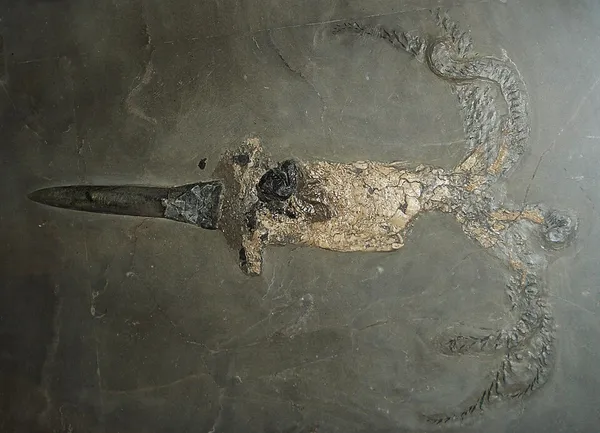
Belemnitida (or belemnites) is an extinct order of squid-like cephalopods that existed from the Late Triassic to Late Cretaceous (and possibly the Eocene). Unlike squid, belemnites had an internal skeleton that made up the cone. The parts are, from the arms-most to the tip, the tongue-shaped pro-ostracum, the conical phragmocone, and the pointed guard. The calcitic guard is the most common belemnite remain. Belemnites, in life, are thought to have had 10 hooked arms and a pair of fins on the guard. The chitinous hooks were usually no bigger than 5 mm (0.20 in), though a belemnite could have had between 100 and 800 hooks in total, using them to stab and hold onto prey. Belemnites were an important food source for many Mesozoic marine creatures, both the adults and the planktonic juveniles and they likely played an important role in restructuring marine ecosystems after they rose to ecological prominence in the aftermath of the Triassic–Jurassic extinction event. While highly abundant for much of the Mesozoic, by the end of the Cretaceous, they had substantially declined relative to their apex during the Jurassic, likely as result of competition with modern coleoids like squid, and become geographically restricted to a few high latitude regions. They may have laid between 100 and 1,000 eggs. Some species may have been adapted to speed and swam in the turbulent open ocean, whereas others resided in the calmer littoral zone (nearshore) and fed off the seafloor. The largest belemnite known, Megateuthis elliptica, would have measured up to 3.11 metres (10.2 ft) in total body length. Belemnites were coleoids, a group that includes squid and octopuses, and are often grouped into the superorder Belemnoidea, though the higher classification of cephalopods is volatile and no clear consensus exists on how belemnites are related to modern coleoids. Guards can give information on the climate, habitat, and carbon cycle of the ancient waters they inhabited. Guards have been found since antiquity and have become part of folklore.
Also on this shelf
Anopheles gambiae.
Empathy.
See also
Uncatalogued shelfText from Wikipedia; plate via Wikimedia Commons. Text CC BY-SA 4.0; plate freely licensed (see Commons). Source record. Images and catalogue data are reproduced from open-access collections.