Science and Medicine
Hemostat
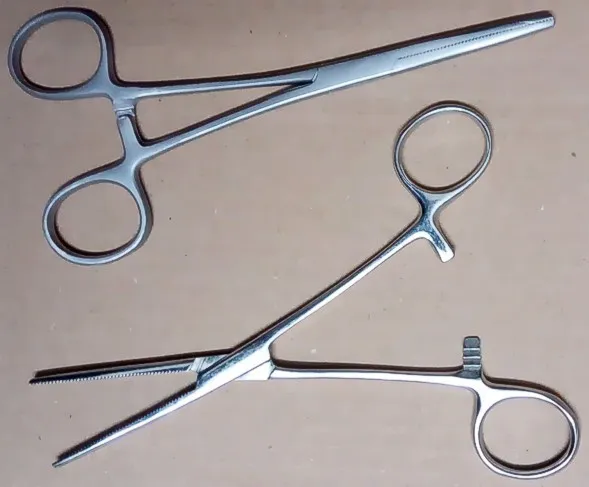
A hemostat (also called a hemostatic clamp; arterial forceps; and pean, after Jules-Émile Péan) is a tool used to control bleeding during surgery. Similar in design to both pliers and scissors, it is used to clamp exposed blood vessels shut. Hemostats belong to a group of instruments that pivot (similar to scissors, and including needle holders, tissue holders, and some other clamps) where the structure of the tip determines the tool's function. A hemostat has handles that can be held in place by their locking mechanism, which usually is a series of interlocking teeth, a few on each handle, that allow the user to adjust the clamping force of the pliers. When the tips are locked together, the force between them is about 40 N (9 lbf). Often in the first phases of surgery, the incision is lined with hemostats on blood vessels that are awaiting ligation.
Also on this shelf
Cholera.
Cockroach.
See also
Uncatalogued shelfText from Wikipedia; plate via Wikimedia Commons. Text CC BY-SA 4.0; plate freely licensed (see Commons). Source record. Images and catalogue data are reproduced from open-access collections.