Science and Medicine
Helicobacter pylori
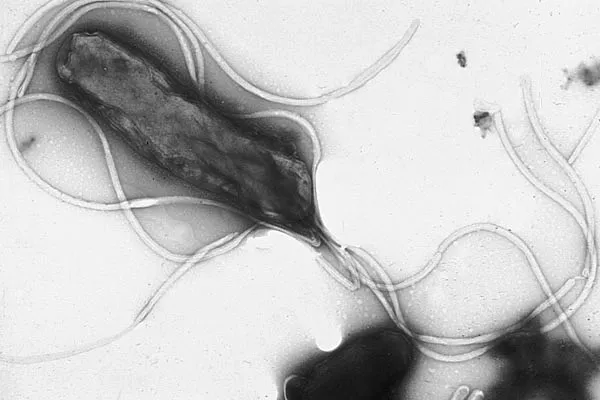
Helicobacter pylori, previously known as Campylobacter pylori, is a gram-negative bacterium best known for its role in infecting the human stomach, often causing gastric ulcers and sometimes stomach cancer. Its helical body (from which the genus name Helicobacter derives) is thought to have evolved to penetrate the mucous lining of the stomach, helped by its flagella, and thereby establish infection. Mutants can have a rod or curved rod shape that exhibits less virulence. While many earlier reports of an association between bacteria and gastric ulcers had existed, such as the works of John Lykoudis, it was only in 1983 when the bacterium was formally described for the first time as the causal agent of gastric ulcers by Australian physician-scientists Barry Marshall and Robin Warren. In 2005, the pair was awarded the Nobel Prize in Physiology or Medicine for their discovery. Infection of the stomach with H. pylori does not necessarily cause illness: over half of the global population is infected, but most individuals are asymptomatic. Persistent colonization with more virulent strains can induce a number of gastric and non-gastric disorders. Gastric disorders due to infection begin with gastritis, or inflammation of the stomach lining. When infection is persistent, the prolonged inflammation will become chronic gastritis. Initially, this will be non-atrophic gastritis, but the damage caused to the stomach lining can bring about the development of atrophic gastritis and ulcers within the stomach itself or the duodenum (the nearest part of the intestine). At this stage, the risk of developing gastric cancer is high. However, the development of a duodenal ulcer confers a comparatively lower risk of cancer. Helicobacter pylori are class 1 carcinogenic bacteria, and potential cancers include gastric MALT lymphoma and gastric cancer. Complications outside the stomach that have been linked to H. pylori include anemia due either to iron deficiency or vitamin B12 deficiency, diabetes, cardiovascular disease, and certain neurological disorders. An inverse association has also been claimed with H. pylori having a positive protective effect against asthma, esophageal cancer, inflammatory bowel disease (including gastroesophageal reflux disease and Crohn's disease), and others. Some studies suggest that H.
Also on this shelf
Ashgabat.
Gideon Mantell.
See also
Uncatalogued shelfText from Wikipedia; plate via Wikimedia Commons. Text CC BY-SA 4.0; plate freely licensed (see Commons). Source record. Images and catalogue data are reproduced from open-access collections.