Science and Medicine
Hormone
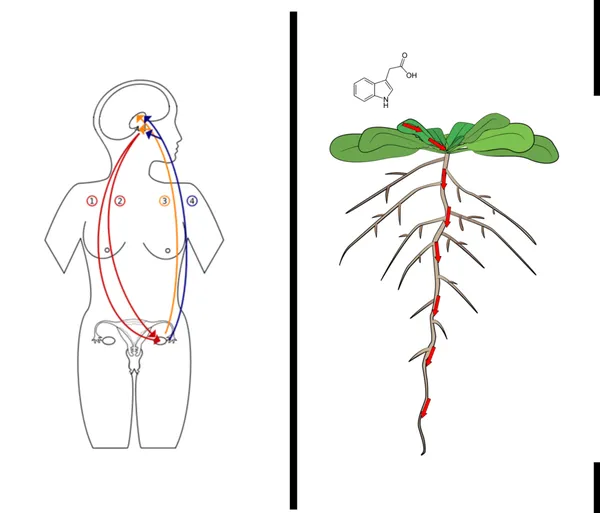
A hormone (from Ancient Greek ὁρμῶν (hormôn) 'setting in motion') is a class of signaling molecules in multicellular organisms that are sent to distant organs or tissues by complex biological processes to regulate physiology and behavior. Hormones are required for the normal development of animals, plants and fungi. Due to the broad definition of a hormone (as a signaling molecule that exerts its effects far from its site of production), numerous kinds of molecules can be classified as hormones. Substances that can be considered hormones include eicosanoids (e.g. prostaglandins and thromboxanes), steroids (e.g. oestrogen and brassinosteroid), amino acid derivatives (e.g. epinephrine and auxin), protein or peptides (e.g. insulin and CLE peptides), and gases (e.g. ethylene and nitric oxide). Hormones are used to communicate between organs and tissues. In vertebrates, hormones are responsible for regulating a wide range of processes including both physiological processes and behavioral activities such as digestion, metabolism, respiration, sensory perception, sleep, excretion, lactation, stress induction, growth and development, movement, reproduction, and mood manipulation. In plants, hormones modulate almost all aspects of development, from germination to senescence. Hormones affect distant cells by binding to specific receptor proteins in the target cell, resulting in a change in cell function. When a hormone binds to the receptor, it results in the activation of a signal transduction pathway that typically activates gene transcription, resulting in increased expression of target proteins. Hormones can also act in non-genomic pathways that synergize with genomic effects. Water-soluble hormones (such as peptides and amines) generally act on the surface of target cells via second messengers. Lipid soluble hormones, (such as steroids) generally pass through the plasma membrane of target cells (both cytoplasmic and nuclear) to act within their nuclei. Brassinosteroids, a type of polyhydroxysteroids, are a sixth class of plant hormones and may be useful as an anticancer drug for endocrine-responsive tumors to cause apoptosis and limit plant growth. Despite being lipid soluble, they nevertheless attach to their receptor at the cell surface. In vertebrates, endocrine glands are specialized organs that secrete hormones into the endocrine signaling system.
Also on this shelf
Basilosaurus.
Coral.
See also
Uncatalogued shelfText from Wikipedia; plate via Wikimedia Commons. Text CC BY-SA 4.0; plate freely licensed (see Commons). Source record. Images and catalogue data are reproduced from open-access collections.