Science and Medicine
Bradykinin
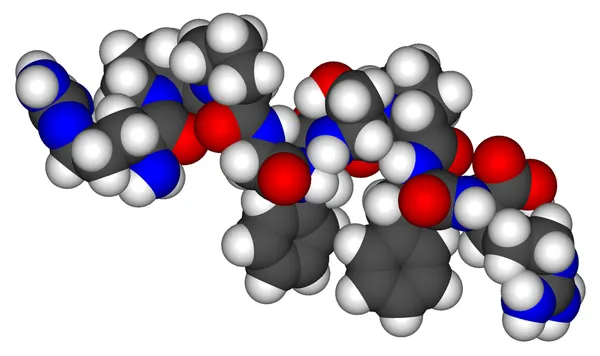
Bradykinin (BK) (from Greek brady- 'slow' + -kinin, kīn(eîn) 'to move') is a peptide that promotes inflammation. It causes arterioles to dilate (enlarge) via the release of prostacyclin, nitric oxide, and endothelium-derived hyperpolarizing factor, and induces smooth muscle constraction via prostaglandin F2. Bradykinin consists of nine amino acids, and is a physiologically and pharmacologically active peptide of the kinin group of proteins. A class of drugs called angiotensin-converting-enzyme inhibitors (ACE inhibitors) increase bradykinin levels by inhibiting its degradation, thereby increasing its blood pressure-lowering effect. ACE inhibitors are used to treat hypertension and heart failure.
Also on this shelf
Ebola virus disease in Mali.
Bibliography of the history of the 1918 influenza pandemic.
See also
Uncatalogued shelfText from Wikipedia; plate via Wikimedia Commons. Text CC BY-SA 4.0; plate freely licensed (see Commons). Source record. Images and catalogue data are reproduced from open-access collections.