Science and Medicine
Copley Medal
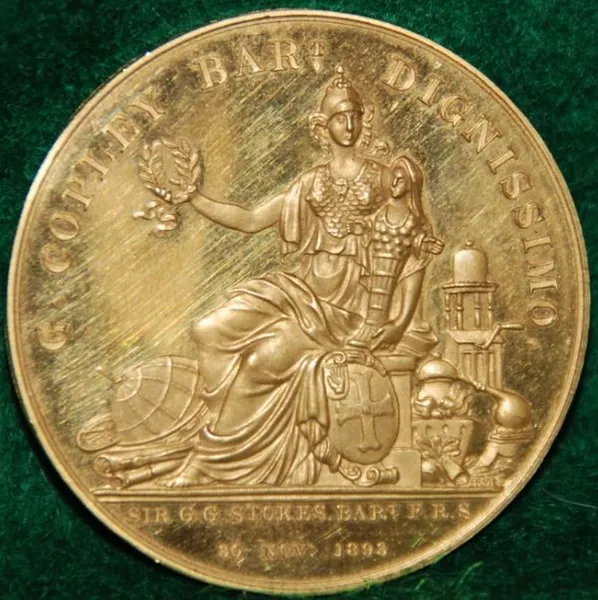
The Copley Medal is the most prestigious award of the Royal Society of the United Kingdom, conferred "for sustained, outstanding achievements in any field of science". The award alternates between the physical sciences or mathematics and the biological sciences. It is widely considered the highest British and Commonwealth award for scientific merit and achievement, and has regularly been included among the most distinguished international scientific awards. Due to its historic significance, the Copley Medal has often been viewed as a predecessor to the Nobel Prize. Given annually, the medal is the oldest Royal Society medal awarded and the oldest surviving scientific award in the world, having first been given in 1731 to Stephen Gray, for "his new Electrical Experiments: – as an encouragement to him for the readiness he has always shown in obliging the Society with his discoveries and improvements in this part of Natural Knowledge". The medal is made of silver-gilt and awarded with a £25,000 prize. It is awarded to "senior scientists" irrespective of nationality, and nominations are considered over three nomination cycles. Since 2022, scientific teams or research groups are collectively eligible to receive the medal; that year, the research team which developed the Oxford–AstraZeneca COVID-19 vaccine became the first collective recipient. John Theophilus Desaguliers has won the medal the most often, winning three times, in 1734, 1736 and 1741. In 1976, Dorothy Hodgkin became the first female recipient; Jocelyn Bell Burnell, in 2021, became the second.
Also on this shelf
Aseem Malhotra.
Ambidexterity.
See also
Uncatalogued shelfText from Wikipedia; plate via Wikimedia Commons. Text CC BY-SA 4.0; plate freely licensed (see Commons). Source record. Images and catalogue data are reproduced from open-access collections.