Science and Medicine
Fascioloides magna
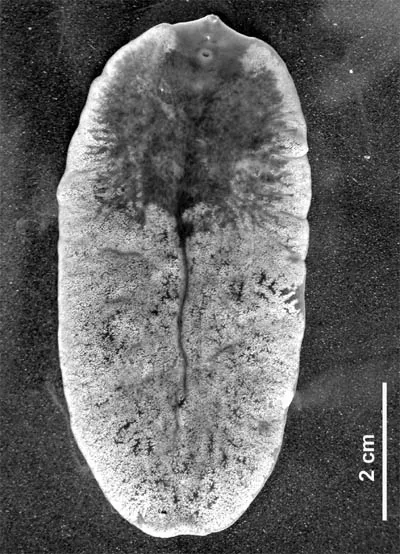
Fascioloides magna, also known as giant liver fluke, large American liver fluke or deer fluke, is trematode parasite that occurs in wild and domestic ruminants in North America and Europe. Adult flukes occur in the liver of the definitive host and feed on blood. Mature flukes measure 4 to 10 centimetres (1+1⁄2 to 4 in) in length × 2 to 3.5 centimetres (3⁄4 to 1+3⁄8 in) in width, and have an oval dorso-ventrally flattened body with oral and ventral sucker. The flukes are reddish-brown in colour and are covered by tegument. As with other digenean trematodes, the life cycle includes intramolluscan phase in snails. The parasite is currently distributed in wild ruminants in North America and Europe, including Austria, Canada, the Czech Republic, Croatia, Germany, Hungary, Italy, Poland, Serbia, Slovakia, and the United States.
Also on this shelf
COVID-19 hospital.
Face masks during the COVID-19 pandemic in the United States.
See also
Uncatalogued shelfText from Wikipedia; plate via Wikimedia Commons. Text CC BY-SA 4.0; plate freely licensed (see Commons). Source record. Images and catalogue data are reproduced from open-access collections.