Science and Medicine
Disc herniation
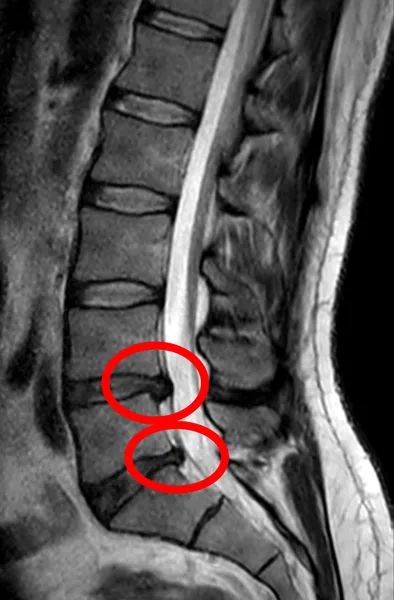
A disc herniation, also known as a spinal disc herniation, is a condition affecting the intervertebral disc between two vertebrae, usually caused by excessive strain or trauma to the spine. It may result in back pain, pain or abnormal sensation in different parts of the body, and physical disability. The most conclusive diagnostic tool for disc herniation is MRI, and treatments may range from painkillers to surgery. The risk of disc herniation may be reduced by maintaining core strength and an awareness of body mechanics including good posture. When a tear in the outer fibrous ring of an intervertebral disc allows the soft, central portion to bulge out beyond the damaged outer ring, the disc is said to be herniated. Disc herniation is frequently associated with age-related degeneration of the outer ring, known as the annulus fibrosus, but is normally triggered by trauma or straining from lifting or twisting. Tears are almost always posterolateral (on the back sides) owing to relative narrowness of the posterior longitudinal ligament relative to the anterior longitudinal ligament. A tear in the disc ring may result in the release of chemicals causing inflammation, which can result in severe pain even in the absence of nerve root compression. Disc herniation may develop from a pre-existing disc protrusion, in which the outermost layers of the annulus fibrosus are still intact, but can bulge when the disc is under pressure. In contrast to a herniation, none of the central portion escapes beyond the outer layers. Most minor herniations heal within several weeks. Anti-inflammatory treatments for pain associated with disc herniation, protrusion, bulge, or disc tear are generally effective. Severe herniations may not heal of their own accord and may require surgery. The condition may be referred to as a slipped disc, but this term is considered inaccurate as the spinal discs are firmly attached between the vertebrae and cannot "slip" out of place.
Also on this shelf
Carl Ludwig.
CoronaVac.
See also
Uncatalogued shelfText from Wikipedia; plate via Wikimedia Commons. Text CC BY-SA 4.0; plate freely licensed (see Commons). Source record. Images and catalogue data are reproduced from open-access collections.