Science and Medicine
Animal
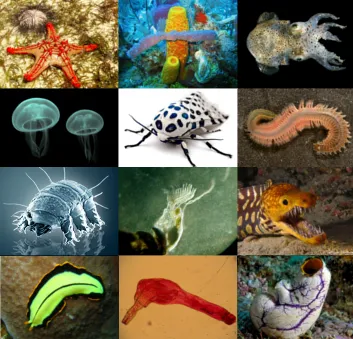
Animals are multicellular, eukaryotic organisms belonging to the biological kingdom Animalia (). Animals consume organic material, breathe oxygen, have muscle cells, can reproduce sexually, and grow from a hollow sphere of cells, the blastula, during embryonic development. With few exceptions, animals are able to move. Animals form a clade, meaning that they arose from a single common ancestor. Over 1.5 million living animal species have been described, of which around 1.05 million are insects, over 85,000 are molluscs, and around 65,000 are vertebrates. It has been estimated there are as many as 7.77 million animal species on Earth. Animal body lengths range from 8.5 μm (0.00033 in) to 33.6 m (110 ft). They have complex ecologies and interactions with each other and their environments, forming intricate food webs. The scientific study of animals is known as zoology, and the study of animal behaviour is known as ethology. The animal kingdom is divided into five major clades, namely Porifera, Ctenophora, Placozoa, Cnidaria and Bilateria. Most living animal species belong to the clade Bilateria, a highly proliferative clade whose members have a bilaterally symmetric and significantly cephalised body plan, and the vast majority of bilaterians belong to two large clades: the protostomes, which include organisms such as arthropods, molluscs, flatworms, annelids and nematodes; and the deuterostomes, which include echinoderms, hemichordates and chordates, the last of which contains the vertebrates. The much smaller basal phylum Xenacoelomorpha have an uncertain position within Bilateria. Animals are first represented in the fossil record in the Ediacaran period, with most modern animal phyla appearing as marine species in the Cambrian explosion, which began around 539 million years ago (Mya), and most classes during the Ordovician radiation 485.4 Mya. Common to all living animals, 6,331 groups of genes have been identified that may have arisen from a single common ancestor that lived about 650 Mya during the Cryogenian period. Historically, Aristotle divided animals into those with blood and those without. Carl Linnaeus created the first hierarchical biological classification for animals in 1758 with his Systema Naturae, which Jean-Baptiste Lamarck expanded into 14 phyla by 1809.
Also on this shelf
Dental extraction.
Abbasid Caliphate.
See also
Uncatalogued shelfText from Wikipedia; plate via Wikimedia Commons. Text CC BY-SA 4.0; plate freely licensed (see Commons). Source record. Images and catalogue data are reproduced from open-access collections.