Science and Medicine
Confocal endoscopy
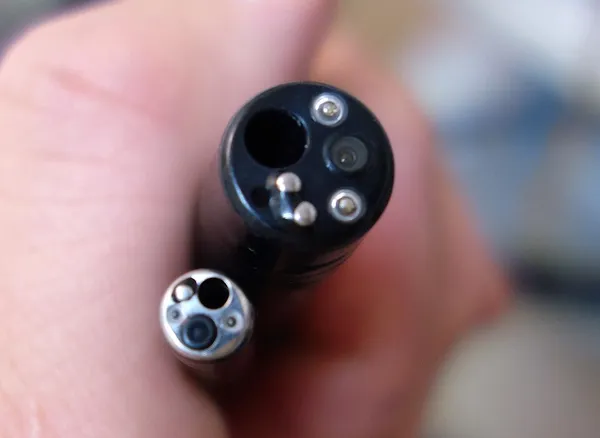
Confocal endoscopy, or confocal laser endomicroscopy (CLE), is a modern imaging technique that allows the examination of real-time microscopic and histological features inside the body. In the word "endomicroscopy", endo- means "within" and -skopein means "to view or observe". CLE, also known as "optical biopsy", can analyse histology and cytology features of a tissue which otherwise is only possible by tissue biopsy. Similar to confocal microscopy, the laser in CLE filtered by the pinhole excites the fluorescent dye through a beam splitter and objective lens. The fluorescent emission then follows similar paths into the detector. A pinhole is used to select emissions from the desired focal plane. Two categories of CLE exist, namely probe-based (pCLE) and the less common endoscopy-based endoscopy (eCLE). CLE can be intubated to study the gastrointestinal (GI) tract and accessory digestive organs with a fluorescent dye. A variety of diseases, including inflammatory bowel disease (IBD) and Barrett's oesophagus, can be diagnosed by the magnified and in-depth view in combination with traditional endoscopy.
Also on this shelf
Ergotism.
Georgios Papanikolaou.
See also
Uncatalogued shelfText from Wikipedia; plate via Wikimedia Commons. Text CC BY-SA 4.0; plate freely licensed (see Commons). Source record. Images and catalogue data are reproduced from open-access collections.