Science and Medicine
LASIK
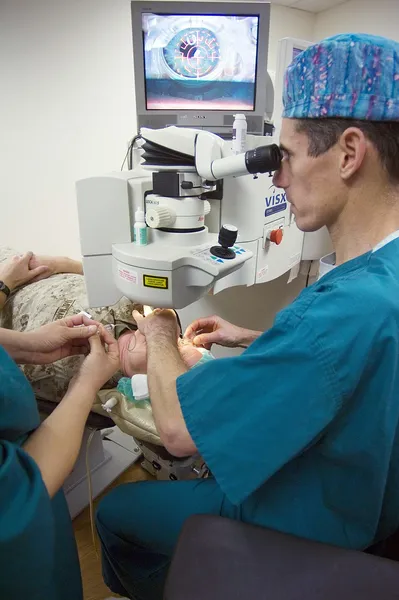
LASIK or Lasik (; "laser-assisted in situ keratomileusis"), commonly referred to as laser eye surgery or laser vision correction, is a type of refractive surgery for the correction of myopia, hypermetropia, and astigmatism. LASIK surgery is performed by an ophthalmologist who uses a femtosecond laser or a microkeratome to create a corneal flap to expose the corneal stroma and then an excimer laser to reshape the corneal stroma in order to improve visual acuity. LASIK is very similar to another surgical corrective procedure, photorefractive keratectomy (PRK), and LASEK. All represent advances over radial keratotomy in the surgical treatment of refractive errors of vision. For people with moderate to high myopia or thin corneas which cannot be treated with LASIK or PRK, the phakic intraocular lens is an alternative. As of 2018, roughly 9.5 million Americans have had LASIK and, globally, between 1991 and 2016, more than 40 million procedures were performed. However, the procedure seemed to be a declining option as of 2015.
Also on this shelf
Howard Markel.
Heroin.
See also
Uncatalogued shelfText from Wikipedia; plate via Wikimedia Commons. Text CC BY-SA 4.0; plate freely licensed (see Commons). Source record. Images and catalogue data are reproduced from open-access collections.