Science and Medicine
Camillo Golgi
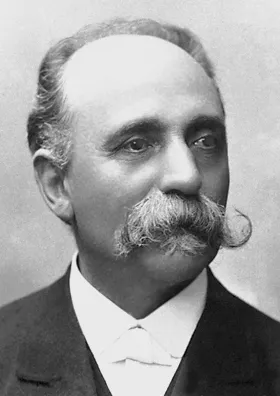
Camillo Golgi (, Italian: [kaˈmilːo ˈɡɔldʒi]; 7 July 1843 – 21 January 1926) was an Italian biologist and pathologist who was awarded the 1906 Nobel Prize in Physiology or Medicine for his works on the central nervous system. He studied medicine at the University of Pavia (where he later spent most of his professional career) between 1860 and 1868 under the tutelage of Cesare Lombroso. Inspired by pathologist Giulio Bizzozero, he pursued research in the nervous system. His discovery of a staining technique called black reaction (sometimes called Golgi's method or Golgi's staining in his honour) in 1873 was a major breakthrough in neuroscience. Several structures and phenomena in anatomy and physiology are named for him, including the Golgi apparatus, the Golgi tendon organ and the Golgi tendon reflex. Golgi and the Spanish biologist Santiago Ramón y Cajal were jointly awarded the Nobel Prize in Physiology or Medicine in 1906 "in recognition of their work on the structure of the nervous system".
Also on this shelf
Africa Centres for Disease Control and Prevention.
1853 yellow fever epidemic.
See also
Uncatalogued shelfText from Wikipedia; plate via Wikimedia Commons. Text CC BY-SA 4.0; plate freely licensed (see Commons). Source record. Images and catalogue data are reproduced from open-access collections.