Science and Medicine
Developmental bioelectricity
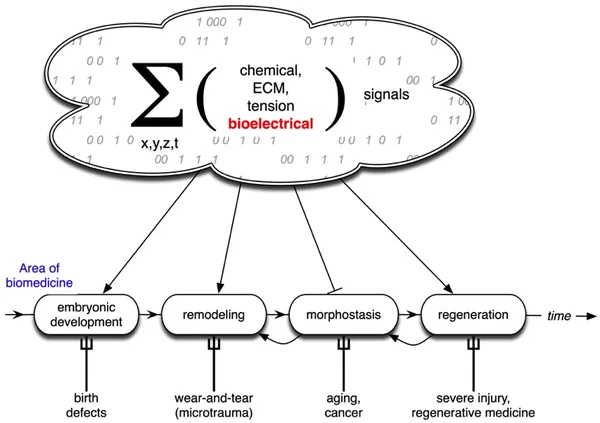
In biology, developmental bioelectricity is the regulation of cell, tissue, and organ-level patterning and behavior by electrical signals during the development of embryonic animals and plants. The charge carrier in developmental bioelectricity is the ion (a charged atom) rather than the electron, and an electric current and field is generated whenever a net ion flux occurs. Cells and tissues of all types use flows of ions to communicate electrically. Endogenous electric currents and fields, ion fluxes, and differences in resting potential across tissues comprise a signalling system. It functions along with biochemical factors, transcriptional networks, and other physical forces to regulate cell behaviour and large-scale patterning in processes such as embryogenesis, regeneration, and cancer suppression.
Also on this shelf
John Michael Montgomery.
Antonio Giordano.
See also
Uncatalogued shelfText from Wikipedia; plate via Wikimedia Commons. Text CC BY-SA 4.0; plate freely licensed (see Commons). Source record. Images and catalogue data are reproduced from open-access collections.