Science and Medicine
Circulatory system
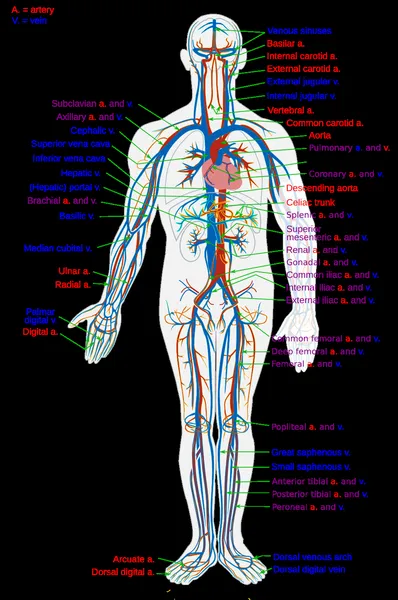
In vertebrates, the circulatory system is a system of organs that includes the heart, blood vessels, and blood which is circulated throughout the body. It includes the cardiovascular system, or vascular system, that consists of the heart and blood vessels (from Greek kardia meaning heart, and Latin vascula meaning vessels). The circulatory system has two divisions, a systemic circulation or circuit, and a pulmonary circulation or circuit. Some sources use the terms cardiovascular system and vascular system interchangeably with circulatory system. The network of blood vessels are the great vessels of the heart including large elastic arteries, and large veins; other arteries, smaller arterioles, capillaries that join with venules (small veins), and other veins. The circulatory system is closed in vertebrates, which means that the blood never leaves the network of blood vessels. Many invertebrates such as arthropods have an open circulatory system with a heart that pumps a hemolymph which returns via the body cavity rather than via blood vessels. Diploblasts such as sponges and comb jellies lack a circulatory system. Blood is a fluid consisting of plasma, red blood cells, white blood cells, and platelets; it is circulated around the body carrying oxygen and nutrients to the tissues and collecting and disposing of waste materials. Circulated nutrients include proteins and minerals and other components include hemoglobin, hormones, and gases such as oxygen and carbon dioxide. These substances provide nourishment, help the immune system to fight diseases, and help maintain homeostasis by stabilizing temperature and natural pH. In vertebrates, the lymphatic system is complementary to the circulatory system. The lymphatic system carries excess plasma (filtered from the circulatory system capillaries as interstitial fluid between cells) away from the body tissues via accessory routes that return excess fluid back to blood circulation as lymph. The lymphatic system is a subsystem that is essential for the functioning of the blood circulatory system; without it the blood would become depleted of fluid. The lymphatic system also works with the immune system. The circulation of lymph takes much longer than that of blood and, unlike the closed (blood) circulatory system, the lymphatic system is an open system.
Also on this shelf
Ebola.
Hyperbaric medicine.
See also
Uncatalogued shelfText from Wikipedia; plate via Wikimedia Commons. Text CC BY-SA 4.0; plate freely licensed (see Commons). Source record. Images and catalogue data are reproduced from open-access collections.