Science and Medicine
Corynocarpus laevigatus
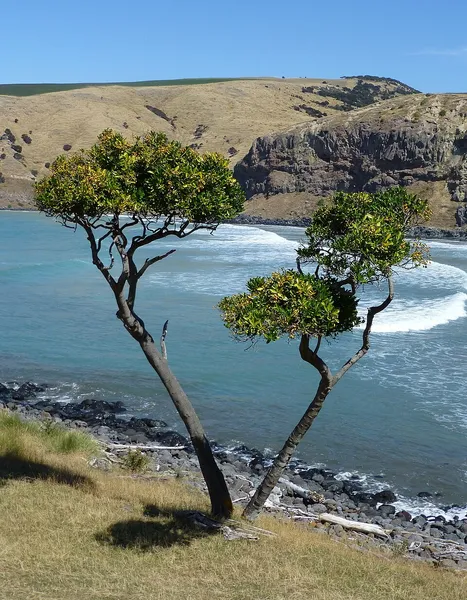
Corynocarpus laevigatus, commonly known as karaka or the New Zealand laurel, is an evergreen tree in the family Corynocarpaceae. It is endemic to New Zealand and is common throughout the North Island and less common in the South Island. C. laevigatus individuals are also found on the Chatham Islands, Kermadec Islands, and the Three Kings Islands. C. laevigatus is mainly a coastal tree, although in the North Island, it is also found inland. Corynocarpus laevigatus was first described in 1776 by the German naturalists Georg and Johann Reinhold Forster. C. laevigatus grows to heights of up to 15–20 metres (50–70 feet) and has a trunk of up to 60 centimetres (20 inches) in diameter. Its leaves are leathery, dark to bright green in colour and up to 15–30 cm (6–10 in) long. C. laevigatus produces large oval-shaped orange-coloured fruits. C. laevigatus seeds are highly toxic to humans and contain poisonous toxins and other glucosides. The fruits are a valuable food source for the kererū and the Chatham Islands pigeon. C. laevigatus has been introduced to the United States for reforestation purposes; it is naturalised and considered an invasive species on several Hawaiian islands and is mainly found on the island of Kauai. It is considered a taonga (cultural treasure) amongst the Māori and Moriori peoples, who valued C. laevigatus for its drupes and seeds. On the Chatham Islands, depictions of Moriori ancestors were carved on to C. laevigatus trees (known as rākau momori) and are considered internationally significant and unique to their culture. An exoplanet originally named HD 137388 was renamed to "Karaka" in 2019 in recognition of the tree's orange-coloured fruit.
Also on this shelf
Barry Zuckerman.
Demographics of Thailand.
See also
Uncatalogued shelfText from Wikipedia; plate via Wikimedia Commons. Text CC BY-SA 4.0; plate freely licensed (see Commons). Source record. Images and catalogue data are reproduced from open-access collections.