Science and Medicine
Fetoscopy
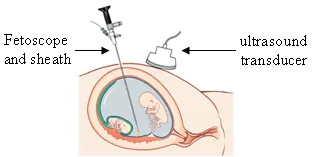
Fetoscopy is an endoscopic procedure during pregnancy to allow surgical access to the fetus, the amniotic cavity, the umbilical cord, and the fetal side of the placenta. A small (3–4 mm) incision is made in the abdomen, and an endoscope is inserted through the abdominal wall and uterus into the amniotic cavity. Fetoscopy allows for medical interventions such as a biopsy (tissue sample) or a laser occlusion of abnormal blood vessels (such as chorioangioma) or the treatment of spina bifida. Fetoscopy is usually performed in the second or third trimester of pregnancy. The procedure can place the fetus at increased risk of adverse outcomes, including fetal loss or preterm delivery, so the risks and benefits must be carefully weighed in order to protect the health of the mother and fetus(es). The procedure is typically performed in an operating room by an obstetrician-gynecologist.
Also on this shelf
Erlikosaurus.
1902 cholera outbreak of the Philippines.
See also
Uncatalogued shelfText from Wikipedia; plate via Wikimedia Commons. Text CC BY-SA 4.0; plate freely licensed (see Commons). Source record. Images and catalogue data are reproduced from open-access collections.