Science and Medicine
Coagulation
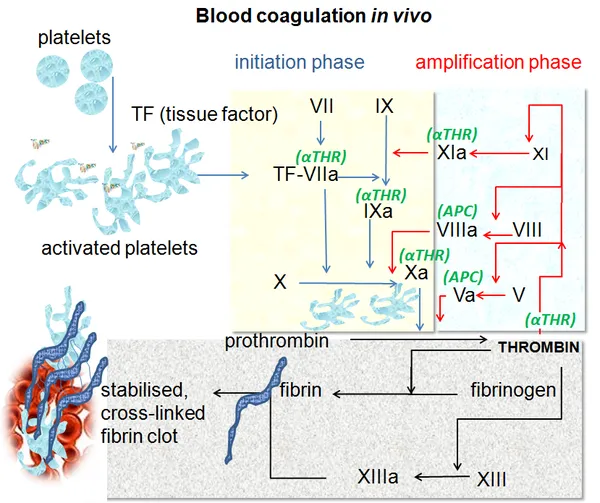
Coagulation, also known as clotting, is the process by which blood changes from a liquid to a gel forming a blood clot. The process involves activation, adhesion and aggregation of platelets, as well as deposition and maturation of fibrin. Coagulation results in hemostasis, the cessation of blood loss from a damaged vessel, allowing repair. Coagulation begins almost instantly after an injury to the endothelium that lines a blood vessel. Exposure of blood to the subendothelial space initiates two processes: changes in platelets, and the exposure of subendothelial platelet tissue factor to coagulation factor VII, which ultimately leads to cross-linked fibrin formation. Platelets immediately form a plug at the site of injury; this is called primary hemostasis. Secondary hemostasis occurs simultaneously: additional coagulation factors beyond factor VII (listed below) respond in a cascade to form fibrin strands, which strengthen the platelet plug. Coagulation is highly conserved throughout biology. In all mammals, coagulation involves both cellular components (platelets) and proteinaceous components (coagulation or clotting factors). The pathway in humans has been the most extensively researched and is the best understood. Disorders of coagulation can result in problems with hemorrhage, bruising, or thrombosis.
Also on this shelf
Blalock–Thomas–Taussig shunt.
Endocrinology.
See also
Uncatalogued shelfText from Wikipedia; plate via Wikimedia Commons. Text CC BY-SA 4.0; plate freely licensed (see Commons). Source record. Images and catalogue data are reproduced from open-access collections.