Science and Medicine
Cystic fibrosis
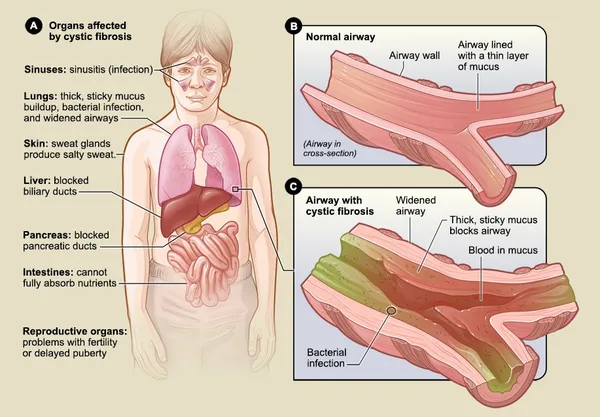
Cystic fibrosis (CF) is a genetic disorder inherited in an autosomal recessive manner that impairs the normal clearance of mucus from the lungs, which facilitates the colonization and infection of the lungs by bacteria, notably Pseudomonas aeruginosa and Staphylococcus aureus. CF is a rare genetic disorder that affects mostly the lungs, but also the pancreas, liver, kidneys, and intestine. The hallmark feature of CF is the accumulation of thick mucus in different organs. Long-term issues include difficulty breathing and coughing up mucus as a result of frequent lung infections. Other signs and symptoms may include sinus infections, poor growth, fatty stool, clubbing of the fingers and toes, and infertility in most males. Different people may have different degrees of symptoms. Cystic fibrosis is inherited in an autosomal recessive manner. It is caused by the presence of mutations in both copies (alleles) of the gene encoding the cystic fibrosis transmembrane conductance regulator (CFTR) protein. Those with a single working copy are carriers and otherwise mostly healthy. CFTR is involved in the production of sweat, digestive fluids, and mucus. When the CFTR is not functional, secretions that are usually thin instead become thick. The condition is diagnosed by a sweat test and genetic testing. The sweat test measures chloride concentration, as people with cystic fibrosis have abnormally salty sweat. Screening of infants at birth takes place in some areas of the world. There is no known cure for cystic fibrosis. CFTR modulators, oral medications that directly target defects in the CFTR protein, have substantially improved survival among people with eligible CFTR variants who have access to treatment. Lung infections are treated with antibiotics which may be given intravenously, inhaled, or by mouth. Sometimes, the antibiotic azithromycin is used long-term. Inhaled hypertonic saline and salbutamol may also be useful. Lung transplantation may be an option if lung function continues to worsen. Pancreatic enzyme replacement and fat-soluble vitamin supplementation are important, especially in the young. Airway clearance techniques such as chest physiotherapy may have some short-term benefit, but long-term effects are unclear.
Also on this shelf
First Faculty of Medicine, Charles University.
Hunterian Society.
See also
Uncatalogued shelfText from Wikipedia; plate via Wikimedia Commons. Text CC BY-SA 4.0; plate freely licensed (see Commons). Source record. Images and catalogue data are reproduced from open-access collections.