Science and Medicine
Demographics of the United States
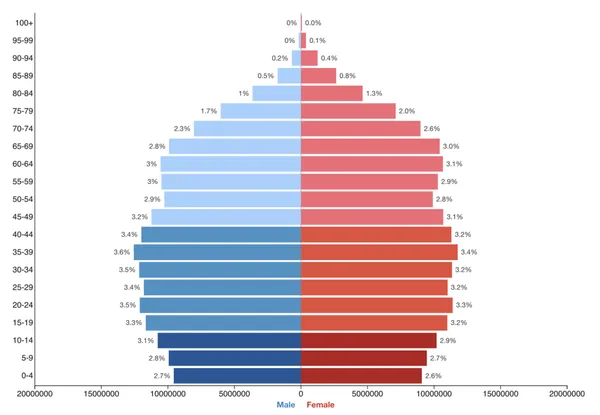
With about 4% of the world's population, the United States is the third most populous country (after India and China), and the most populous in the Americas and the Western Hemisphere. Its estimated population was 341,784,857 on July 1, 2025, according to the U.S. Census Bureau. The country's population grew by 1.8 million, or 0.5%, between 2024 and 2025, due to a decline in net international migration. The previous year, the Census Bureau had reported a population increase of 0.98% between 2023 and 2024, near the global population growth rate of 1.03%. These figures include the 50 states and the federal capital, Washington, D.C., but exclude the 3.6 million residents of five unincorporated U.S. territories (Puerto Rico, Guam, the U.S. Virgin Islands, American Samoa, and the Northern Mariana Islands) as well as several minor uninhabited island possessions. By several metrics, including racial and ethnic background, religious affiliation, and percentage of rural and urban divide, the state of Illinois is the most representative of the larger demography of the United States. The United States population almost quadrupled during the 20th century, with an average growth rate of about 1.3% a year, from about 76 million in 1900 to 281 million in 2000. It is estimated to have reached the 200 million mark in 1967, and the 300 million mark on October 17, 2006. Foreign-born immigration caused the U.S. population to continue its rapid increase, with this population doubling from almost 20 million in 1990 to over 45 million in 2015, representing one-third of the population increase. The U.S. Census Bureau reported in late 2024 that recent immigration to the United States had more than offset the country's lower birth rates: "Net international migration's influence on population trends has increased over the last few years. Since 2021, it accounted for the majority of the nation's growth—a departure from the last two decades, when natural increase was the main factor." This in turn led to an increase in the U.S. population in each of the years 2022, 2023, and 2024 (+0.58%, +0.83%, and +0.98% respectively). Net international migration slowed to a record low in 2025, however, and so did U.S. population growth during that year (+0.5%). Population growth is fastest among minorities as a whole, and according to a 2020 U.S. Census Bureau analysis, 50% of U.S.
Also on this shelf
Bennet Omalu.
Bioprospecting.
See also
Uncatalogued shelfText from Wikipedia; plate via Wikimedia Commons. Text CC BY-SA 4.0; plate freely licensed (see Commons). Source record. Images and catalogue data are reproduced from open-access collections.