Science and Medicine
Islamic world
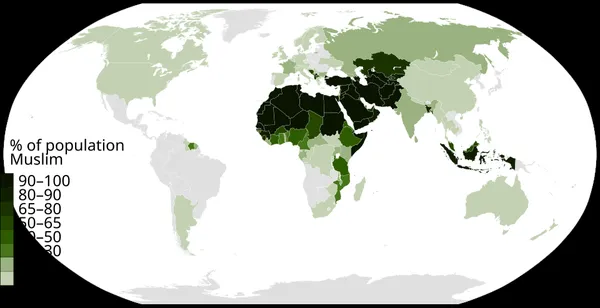
The terms Islamic world and Muslim world commonly refer to the Islamic community, which is also known as the Ummah. This consists of all those who adhere to the religious beliefs, politics, and laws of Islam or to societies in which Islam is practiced. In a modern geopolitical sense, these terms refer to countries in which Islam is widespread, although there are no agreed criteria for inclusion. The term Muslim-majority countries is an alternative often used for the latter sense. The history of the Muslim world spans about 1,400 years and includes a variety of socio-political developments, as well as advances in the arts, science, medicine, philosophy, law, economics and technology during the Islamic Golden Age. Muslims look for guidance to the Quran and believe in the prophetic mission of the Islamic prophet Muhammad, but disagreements on other matters have led to the appearance of different religious schools of thought and sects within Islam. Early Muslim conquests culminated in the Umayyad Caliphate being established across three continents (Asia, Africa, and Europe). In the modern era, most of the Muslim world came under European colonial domination. The nation states that emerged in the post-colonial era have adopted a variety of political and economic models, and they have been affected by secular as well as religious trends. As of 2013, the combined GDP (nominal) of 50 Muslim majority countries was US$5.7 trillion. As of 2016, they contributed 8% of the world's total. In 2020, the Economy of the Organisation of Islamic Cooperation which consists of 57 member states had a combined GDP(PPP) of US$ 24 trillion which is equal to about 18% of world's GDP or US$ 30 trillion with 5 OIC observer states which is equal to about 22% of the world's GDP. Some OIC member countries - Ivory Coast, Guyana, Gabon, Mozambique, Nigeria, Suriname, Togo and Uganda are not Muslim-majority. As of 2020, 1.8 billion or more than 25% of the world population are Muslims. By the percentage of the total population in a region considering themselves Muslim, 91% in the Middle East-North Africa (MENA), 89% in Central Asia, 40% in Southeast Asia, 31% in South Asia, 30% in Sub-Saharan Africa, 25% in Asia, 1.4% in Oceania, 6% in Europe, and 1% in the Americas. Most Muslims are of one of two denominations: Sunni Islam (87–90%) and Shia (10–13%).
Also on this shelf
Biological warfare.
Chewing gum.
See also
- ▸Heroin
- ▸40th Light Anti-Aircraft Regiment, Royal Artillery
- ▸Coalition for Epidemic Preparedness Innovations
Text from Wikipedia; plate via Wikimedia Commons. Text CC BY-SA 4.0; plate freely licensed (see Commons). Source record. Images and catalogue data are reproduced from open-access collections.