Science and Medicine
Facioscapulohumeral muscular dystrophy
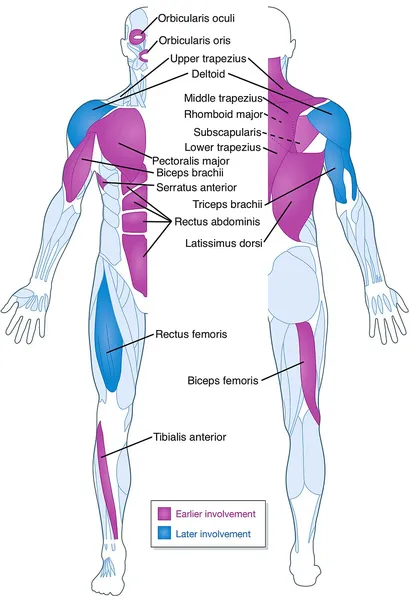
Facioscapulohumeral muscular dystrophy (FSHD) is a type of muscular dystrophy, a group of heritable diseases that cause degeneration of muscle and progressive weakness. Per the name, FSHD tends to sequentially weaken the muscles of the face, those that position the scapula, and those overlying the humerus bone of the upper arm. These areas can be spared. Muscles of other areas usually are affected, especially those of the chest, abdomen, spine, and shin. Most skeletal muscle can be affected in advanced disease. Abnormally positioned, termed 'winged', scapulas are common, as is the inability to lift the foot, known as foot drop. The two sides of the body are often affected unequally. Weakness typically manifests at ages 15–30 years. FSHD can also cause hearing loss and blood vessel abnormalities at the back of the eye. FSHD is caused by a genetic mutation leading to deregulation of the DUX4 gene. Normally, DUX4 is expressed (i.e., turned on) only in select human tissues, most notably in the very young embryo. In the remaining tissues, it is repressed (i.e., turned off). In FSHD, this repression fails in muscle tissue, allowing sporadic expression of DUX4 throughout life. Deletion of DNA in the region surrounding DUX4 is the causative mutation in 95% of cases, termed "D4Z4 contraction" and defining FSHD type 1 (FSHD1). FSHD caused by other mutations is FSHD type 2 (FSHD2). To develop the disease, a 4qA allele is also required, and is a common variation in the DNA next to DUX4. The chances of a D4Z4 contraction with a 4qA allele being passed on to a child are 50% (autosomal dominant); in 30% of cases, the mutation arose spontaneously. Mutations of FSHD cause inadequate DUX4 repression by unpacking the DNA around DUX4, making it accessible to be copied into messenger RNA (mRNA). The 4qA allele stabilizes this DUX4 mRNA, allowing it to be used for production of DUX4 protein. DUX4 protein is a modulator of hundreds of other genes, many of which are involved in muscle function. How this genetic modulation causes muscle damage remains unclear. Signs, symptoms, and diagnostic tests can suggest FSHD; genetic testing usually provides a definitive diagnosis. FSHD can be presumptively diagnosed in an individual with signs/symptoms and an established family history. No intervention has proven effective in slowing the progression of weakness.
Also on this shelf
Doctor Mike.
Emil du Bois-Reymond.
See also
Uncatalogued shelfText from Wikipedia; plate via Wikimedia Commons. Text CC BY-SA 4.0; plate freely licensed (see Commons). Source record. Images and catalogue data are reproduced from open-access collections.