Photography
Cyanotype
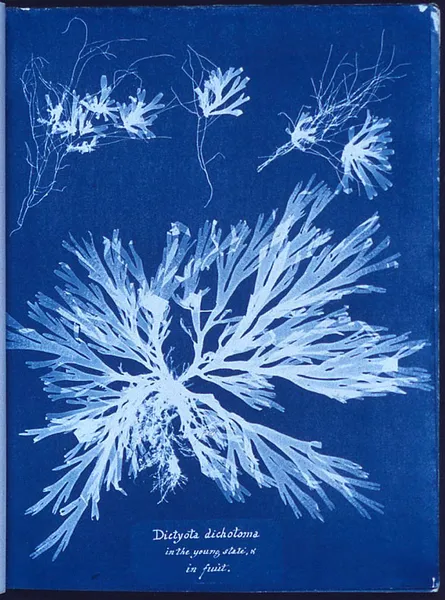
The cyanotype (from Ancient Greek: κυάνεος, kyáneos 'dark blue' and τύπος, týpos 'mark, impression, type') is a slow-reacting, photographic printing formulation sensitive to a limited near-ultraviolet and blue light spectrum, the range of 300 nm to 400 nm, known as UVA radiation. It produces a monochrome, blue-coloured print on a range of supports, and is often used for art and reprography in the form of blueprints. For any purpose, the process usually uses two chemicals – ferric ammonium citrate or ferric ammonium oxalate, and potassium ferricyanide, and only water to develop and fix. Announced in 1842, it is still in use.
Also on this shelf
Adolf Miethe.
Akintunde Akinleye.
See also
Uncatalogued shelfText from Wikipedia; plate via Wikimedia Commons. Text CC BY-SA 4.0; plate freely licensed (see Commons). Source record. Images and catalogue data are reproduced from open-access collections.