Photography
Circle of confusion
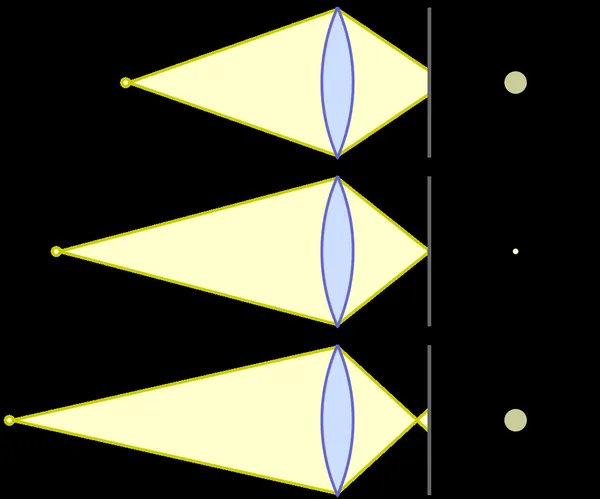
In optics, a circle of confusion (CoC) is an optical spot caused by a cone of light rays from a lens not coming to a perfect focus when imaging a point source. It is also known as disk of confusion, circle of indistinctness, blur circle, or blur spot. In photography, the circle of confusion is used to determine the depth of field, the part of an image that is acceptably sharp. A standard value of CoC is often associated with each image format, but the most appropriate value depends on visual acuity, viewing conditions, and the amount of enlargement. Usages in context include maximum permissible circle of confusion, circle of confusion diameter limit, and the circle of confusion criterion. Real lenses do not focus all rays perfectly, so that even at best focus, a point is imaged as a spot rather than a point. The smallest such spot that a lens can produce is often referred to as the circle of least confusion.
Also on this shelf
Bruno Blum.
Flash (photography).
See also
Uncatalogued shelfText from Wikipedia; plate via Wikimedia Commons. Text CC BY-SA 4.0; plate freely licensed (see Commons). Source record. Images and catalogue data are reproduced from open-access collections.