Photography
Battle of Iwo Jima
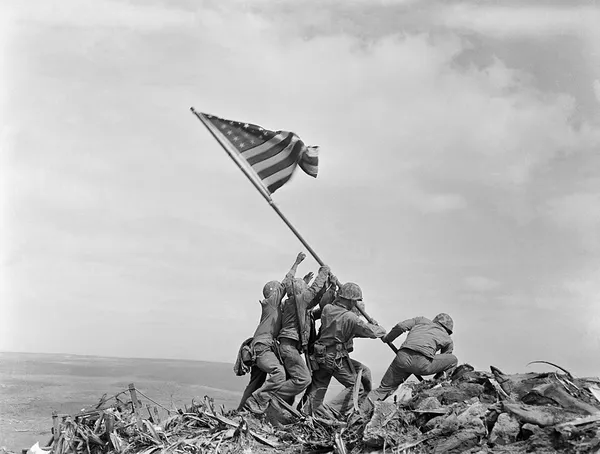
The Battle of Iwo Jima (硫黄島の戦い, Iōtō no Tatakai,or Iōjima no Tatakai; 19 February – 26 March 1945) was a major battle in which the United States Marine Corps (USMC), United States Navy (USN), and United States Army (USA) landed on and eventually captured the island of Iwo Jima from the Imperial Japanese Army (IJA) during World War II. The American invasion, designated Operation Detachment, had the goal of capturing the island with its two airfields: South Field and Central Field. The Japanese Army positions on the island were heavily fortified, with a dense network of bunkers, hidden artillery positions, and 18 km (11 mi) of tunnels. American ground forces were supported by extensive naval artillery, and enjoyed complete air supremacy provided by US Navy, Army, and Marine Corps aviators throughout. The five-week battle saw some of the fiercest and bloodiest fighting of the Pacific War. Unique among Pacific War battles involving amphibious island landings, total American casualties exceeded those of the Japanese, with a ratio of three American casualties for every two Japanese. Of the 21,000 Japanese soldiers on Iwo Jima at the beginning of the battle, only 216 were taken prisoner, some only captured because they had been knocked unconscious or otherwise disabled. Most Japanese were killed in action, but 3,000 or more continued to resist within various cave systems on the island after most major fighting ended, until they were hunted down and killed by the US Army, with some eventually surrendering. The invasion of Iwo Jima was controversial, with retired Chief of Naval Operations William V. Pratt stating that the island was useless to the Army as a staging base and useless to the Navy as a fleet base. The island's airfield did support P-51 Mustang long-range escort fighters to protect B-29 Superfortress bombers en route to Japan, and also for emergency landings of B-29s, although these were of limited value late in the war. The Japanese continued to maintain early-warning radar capabilities on the island of Rota, which was never invaded by American forces. Experiences with previous Pacific island battles suggested that the island would be well-defended and that seizing it would result in significant casualties.
Also on this shelf
135 film.
Associated Press.
See also
Uncatalogued shelfText from Wikipedia; plate via Wikimedia Commons. Text CC BY-SA 4.0; plate freely licensed (see Commons). Source record. Images and catalogue data are reproduced from open-access collections.