Photography
F-number
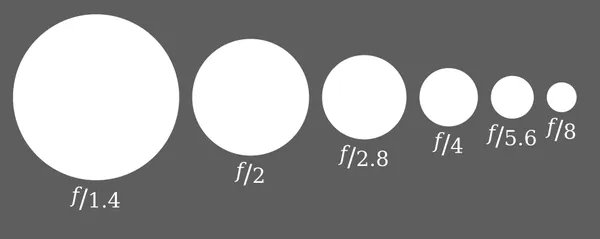
An f-number is a measure of the light-gathering ability of an optical system such as a camera lens. It is defined as the ratio of the system's focal length to the diameter of the entrance pupil ("clear aperture"). The f-number is also known as the focal ratio, f-ratio, or f-stop, and it is key in determining the depth of field, diffraction, and exposure of a photograph. The f-number is dimensionless and is usually expressed using a lower-case hooked f with the format f/N, where N is the f-number. The f-number is also known as the inverse relative aperture, because it is the inverse of the relative aperture, defined as the aperture diameter divided by the focal length. A lower f-number means a larger relative aperture and more light entering the system, while a higher f-number means a smaller relative aperture and less light entering the system. The f-number is related to the numerical aperture (NA) of the system, which measures the range of angles over which light can enter or exit the system. The numerical aperture takes into account the refractive index of the medium in which the system is working, while the f-number does not. The f-number is used as an indication of the light-gathering ability of a lens, i.e. the illuminance it delivers to the film or sensor for a given subject luminance. Although this usage is common, it is an approximation that ignores the effects of the focusing distance and the light transmission of the lens. When these effects cannot be ignored, the working f-number or the T-stop is used instead of the f-number.
Also on this shelf
Bruce Davidson (photographer).
Ben Gascoigne.
See also
Uncatalogued shelfText from Wikipedia; plate via Wikimedia Commons. Text CC BY-SA 4.0; plate freely licensed (see Commons). Source record. Images and catalogue data are reproduced from open-access collections.