Photography
Autographic film
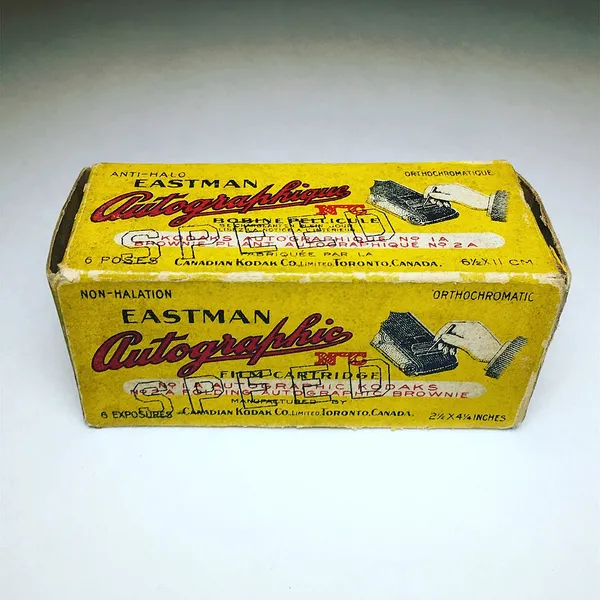
The autographic system for roll film was launched by Kodak in 1914, and allowed the photographer to add written information on the film at the time of exposure. The system was patented by Henry Jacques Gaisman, inventor and safety razor manufacturer. George Eastman purchased the rights for US$300,000. It consisted of a tissue-like carbon paper sandwiched between the film and the paper backing. Text was entered using a metal stylus, and would appear in the margin of the processed print. The system was common on early consumer cameras but became unpopular in the 1920s, and was discontinued in 1932. Kodak's autographic films had "A" prepended to the film size designation. Thus, standard 122 film would be labeled "122" and autographic 122 would be "A122". Autographic roll film sizes were A116, A118, A120, A122, A123, A126, A127, and A130. The autographic feature was marketed as having no extra charge. In 1915, Kodak also sold upgrade autographic backs for their existing cameras.
Also on this shelf
Comics journalism.
Frank Herbert.
See also
Uncatalogued shelfText from Wikipedia; plate via Wikimedia Commons. Text CC BY-SA 4.0; plate freely licensed (see Commons). Source record. Images and catalogue data are reproduced from open-access collections.