Photography
French Indochina in World War II
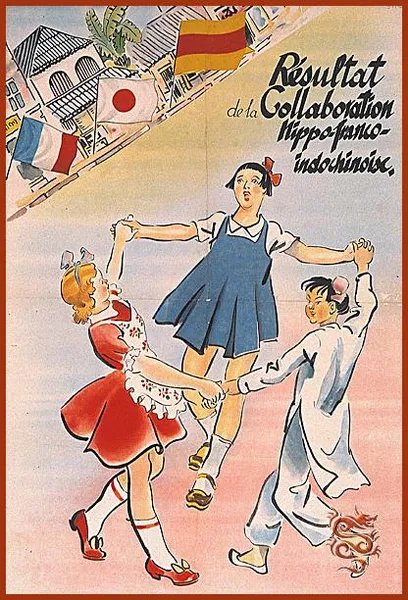
In mid-1940, Nazi Germany rapidly defeated the French Third Republic, and the colonial administration of French Indochina (modern-day Vietnam, Laos and Cambodia) passed to the French State (Vichy France). Many concessions were granted to the Empire of Japan, such as the use of ports, airfields, and railroads. Japanese troops first entered parts of Indochina in September 1940, and by July 1941 Japan had extended its control over the whole of French Indochina. The United States, concerned by Japanese expansion, started putting embargoes on exports of steel and oil to Japan from July 1940. The desire to escape these embargoes and to become self-sufficient in resources ultimately contributed to Japan's decision to attack on 7 December 1941, the British Empire (in Hong Kong and Malaya) and simultaneously the United States (in the Philippines and at Pearl Harbor, Hawaii). This led to the United States declaring war against Japan on 8 December 1941. The United States then joined the side of the British Empire, at war with Germany since 1939, and its existing allies in the fight against the Axis powers. Indochinese communists had set up a covert headquarters in Cao Bằng Province in 1941, but most of the Vietnamese resistance to Japan, France, or both, including both communist and non-communist groups, remained based over the border, in China. As part of their opposition to Japanese expansion, the Chinese had fostered the formation of a Vietnamese nationalist resistance movement, the Dong Minh Hoi (DMH), in Nanking in 1935/1936; this included communists, but was not controlled by them. This did not provide the desired results, so the Chinese Communist Party sent Ho Chi Minh to Vietnam in 1941 to lead an underground centered on the communist Viet Minh. Ho was the senior Comintern agent in Southeast Asia, and was in China as an advisor to the Chinese communist armed forces. This mission was assisted by European intelligence agencies, and later the US Office of Strategic Services (OSS). Free French intelligence also tried to affect developments in the Vichy-Japanese collaboration. In March 1945, the Japanese imprisoned the French administrators and took direct control of Vietnam until the end of the war.
Also on this shelf
1939 New York World's Fair pavilions and attractions.
HDR PhotoStudio.
See also
Uncatalogued shelfText from Wikipedia; plate via Wikimedia Commons. Text CC BY-SA 4.0; plate freely licensed (see Commons). Source record. Images and catalogue data are reproduced from open-access collections.