Photography
Consequences of the Black Death
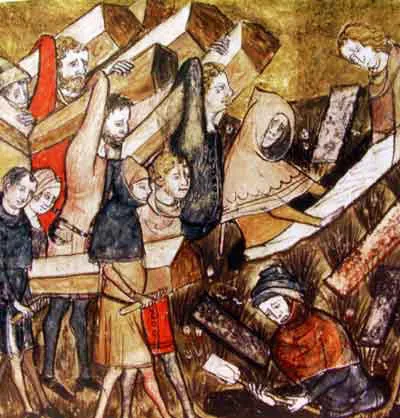
The Black Death peaked in Europe between 1348 and 1350, with an estimated third of the continent's population ultimately succumbing to the disease. Often simply referred to as "The Plague", the Black Death had both immediate and long-term effects on human population across the world as one of the most devastating pandemics in human history, including a series of biological, social, economic, political and religious upheavals that had profound effects on the course of world history, especially European history. Symptoms of the Bubonic Plague included painful and enlarged or swollen lymph nodes, headaches, chills, fatigue, vomiting, and fevers, and within 3 to 5 days, 80% of the victims would be dead. Historians estimate that it reduced the total world population from 475 million to between 350 and 375 million. In most parts of Europe, it took nearly 80 years for population sizes to recover, and in some areas, it took more than 150 years. From the perspective of many of the survivors, the effect of the plague may have been ultimately favourable, as the massive reduction of the workforce meant their labour was suddenly in higher demand. R. H. Hilton has argued that the English peasants who survived found their situation to be much improved. For many Europeans, the 15th century was a golden age of prosperity and new opportunities. The land was plentiful, wages were high and serfdom had all but disappeared. A century later, as population growth resumed, the lower classes once again faced deprivation and famine.
Also on this shelf
Beatrice Tonnesen.
Gunfight at the O.K. Corral.
See also
Uncatalogued shelfText from Wikipedia; plate via Wikimedia Commons. Text CC BY-SA 4.0; plate freely licensed (see Commons). Source record. Images and catalogue data are reproduced from open-access collections.