Photography
Frank S. Matsura
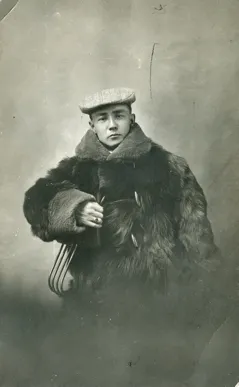
Frank (Sakae) Matsura (1873–1913) was an early 20th-century Japanese photographer who travelled from Japan to America in 1901 where he lived until his early death. More than 1,800 of his frontier-era photographs and glass plate negatives have been preserved by the Okanogan County Historical Society and Washington State University. He was born Sakae Matsuura (松浦 栄, Matsūra Sakae) in 1873, a descendant of Emperor Saga, the 52nd emperor of Japan, through the Matsuura, lords of Hirado Island (northwest of Kyūshū). For unknown reasons, Matsura led his friends and acquaintances to believe he was seven years younger than he actually was. For example, the US Census sheet for 1910 lists his age as 28, and the headstone on his grave states "aged 32 years" in 1913. Researchers discovered his passport application dated 1901 for a "Sakae Matsuura" that lists his age at 27. Matsura's earliest photos give his name as Frank S. Matsuura. Frank S. Matsura's father and uncle were samurai, serving Tokugawa Yoshinobu, 15th Shōgun of the Tokugawa Shogunate. After the Meiji Restoration in 1868, the family entered the tea business. Matsura's parents died, and he was raised by an uncle and aunt, learning English at a school they founded in Tokyo. As further evidence of his family's high standing, he possessed a ceremonial sword. In 1903, he answered an ad in a Seattle newspaper for a cook's helper and laundryman placed by Jesse Dillabough, owner of the Elliott Hotel in Conconully, Washington, and was hired. He arrived with his camera equipment and began photographing the Okanogan region. His photographic subjects were wide and varied and included portraits, infrastructure projects such as the construction of Conconully Dam, Native Americans, celebrations and parades, stage coaches, riverboats, farming and ranching, and virtually all aspects of the lives of the people of Okanogan county. For four years he worked at the Elliott Hotel, developing his pictures in the laundry, before relocating to the growing city of Okanogan in 1907. In Okanogan, he built a two-room store on First Avenue which served as a studio and darkroom. Although business was initially slow, Matsura became popular for his portraits, and promotional photos of the Okanogan.
Also on this shelf
Baburao Painter.
Fred Stein.
See also
Uncatalogued shelfText from Wikipedia; plate via Wikimedia Commons. Text CC BY-SA 4.0; plate freely licensed (see Commons). Source record. Images and catalogue data are reproduced from open-access collections.