Photography
1930s
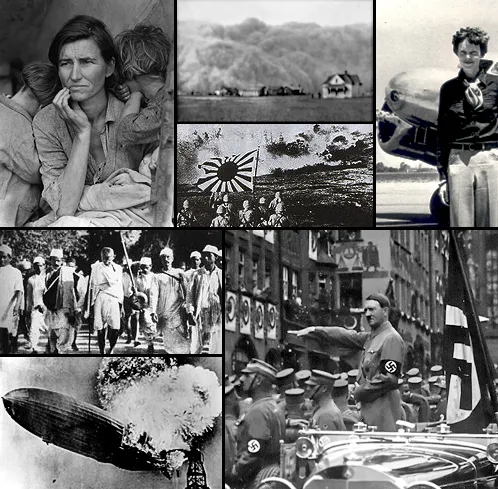
The 1930s (pronounced "nineteen-thirties"; shortened to the "'30s" and referred to as the "Thirties") was the decade that began on January 1, 1930 and ended on December 31, 1939. In the United States, the Dust Bowl led to the nickname the "Dirty Thirties". The decade was defined by a global economic and political crisis that culminated in the Second World War. It saw the collapse of the international financial system, beginning with the Wall Street crash of 1929, the largest stock market crash in American history. The subsequent economic downfall, called the Great Depression, had traumatic social effects worldwide, leading to widespread poverty and unemployment, especially in the economic superpower of the United States and in Germany, which was already struggling with the payment of reparations for the First World War. The Dust Bowl in the United States (which led to the nickname the "Dirty Thirties") exacerbated the scarcity of wealth. U.S. President Franklin D. Roosevelt, who took office in 1933, introduced a program of broad-scale social reforms and stimulus plans called the New Deal in response to the crisis. The Soviet Union's second five-year plan gave heavy industry top priority, putting the Soviet Union not far behind Germany as one of the major steel-producing countries of the world, while also improving communications. First-wave feminism made advances, with women gaining the right to vote in South Africa (1930, whites only), Brazil (1933), and Cuba (1933). Following the rise of Adolf Hitler and the emergence of the NSDAP as the country's sole legal party in 1933, Germany imposed a series of laws which discriminated against Jews and other ethnic minorities. Germany adopted an aggressive foreign policy, remilitarizing the Rhineland (1936), annexing Austria (1938) and the Sudetenland (1938), before invading Poland (1939) and starting World War II near the end of the decade. Italy likewise continued its already aggressive foreign policy, defeating the Libyan resistance (1932) before invading Ethiopia (1935) and then Albania (1939). Both Germany and Italy became involved in the Spanish Civil War, supporting the eventually victorious Nationalists led by Francisco Franco against the Republicans, who were in turn supported by the Soviet Union.
Also on this shelf
Illecillewaet Glacier.
1939 New York World's Fair pavilions and attractions.
See also
Uncatalogued shelfText from Wikipedia; plate via Wikimedia Commons. Text CC BY-SA 4.0; plate freely licensed (see Commons). Source record. Images and catalogue data are reproduced from open-access collections.