Photography
Assassination of John F. Kennedy
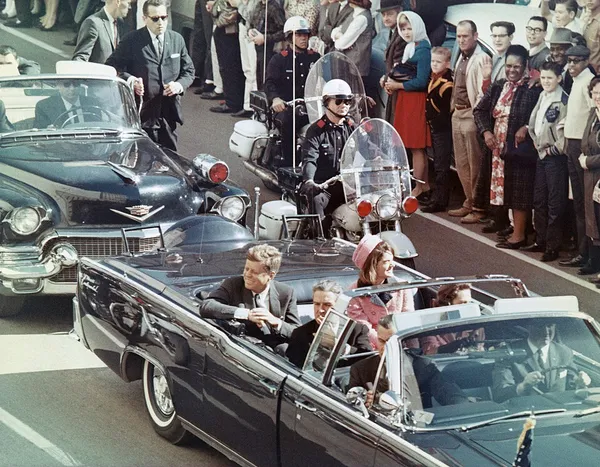
On Friday, November 22, 1963, John F. Kennedy, the 35th president of the United States, was assassinated while riding in a presidential motorcade through Dallas, Texas. Kennedy was in the vehicle with First Lady Jacqueline Kennedy, Texas governor John Connally, and Connally's wife Nellie, when he was fatally shot from the nearby Texas School Book Depository by Lee Harvey Oswald, a former U.S. Marine. The motorcade rushed to Parkland Memorial Hospital, where Kennedy was pronounced dead about 30 minutes after the shooting; Connally was also wounded in the attack but recovered. Vice President Lyndon B. Johnson was hastily sworn in as president two hours and eight minutes later aboard Air Force One at Dallas Love Field. After the assassination, Oswald returned home to retrieve a pistol; he shot and killed a lone Dallas policeman J. D. Tippit shortly afterwards. Around 70 minutes after Kennedy and Connally were shot, Oswald was apprehended by the Dallas Police Department and charged under Texas state law with the murders of Kennedy and Tippit. Two days later, as live television cameras covered Oswald being moved through the basement of Dallas Police Headquarters, he was fatally shot by Dallas nightclub operator Jack Ruby. Like Kennedy, Oswald was taken to Parkland Memorial Hospital, where he soon died. Ruby was convicted of Oswald's murder, though the decision was overturned on appeal, and Ruby died in prison in 1967 while awaiting a new trial. After a 10-month investigation, the Warren Commission concluded that Oswald assassinated Kennedy, and that there was no evidence that either Oswald or Ruby was part of a conspiracy. In 1967, New Orleans district attorney Jim Garrison brought the only trial for Kennedy's murder against businessman Clay Shaw; Shaw was acquitted. Subsequent federal investigations—such as the Rockefeller Commission and Church Committee—agreed with the Warren Commission's general findings. In its 1979 report, the United States House Select Committee on Assassinations (HSCA) concluded that Kennedy was likely "assassinated as a result of a conspiracy". The HSCA did not identify possible conspirators, but concluded that there was "a high probability that two gunmen fired at [the] President". The HSCA's conclusions were largely based on a police Dictabelt recording, which was subsequently debunked by the U.S.
Also on this shelf
Britt Ekland.
Elliott Roosevelt (general).
See also
Uncatalogued shelfText from Wikipedia; plate via Wikimedia Commons. Text CC BY-SA 4.0; plate freely licensed (see Commons). Source record. Images and catalogue data are reproduced from open-access collections.