Photography
First Indochina War
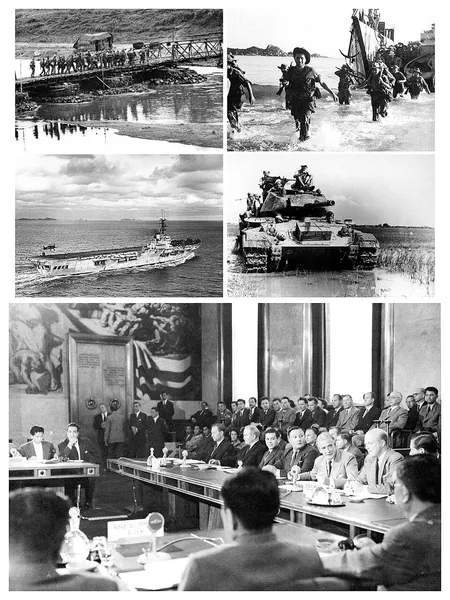
The First Indochina War, known alternatively as the French Indochina War, was fought in French Indochina between the French Union and the Viet Minh and their respective allies, from 19 December 1946 until 11 August 1954. Most of the engagements of this conflict occurred in Vietnam. At the Potsdam Conference in July 1945, the Allied Combined Chiefs of Staff decided that Indochina south of latitude 16° north was to be included in the South East Asia Command under British Admiral Mountbatten. On 25 August 1945, Vietnamese Emperor Bảo Đại abdicated, handing power over to the Viet Minh. On 2 September, Ho Chi Minh proclaimed the establishment of the Democratic Republic of Vietnam (DRV). Also in September 1945, Chinese forces entered Hanoi, and Japanese forces north of the 16th parallel surrendered to Generalissimo Chiang Kai-shek. At the same time, British forces landed in Saigon, and Japanese forces in the south surrendered to the British. The Chinese Nationalists acknowledged the DRV and the communist-led Viet Minh, then in power in Hanoi. The British refused to do that in Saigon, in deference to the French. On 23 September 1945, French forces overthrew the Viet Minh administration in Saigon and declared French authority restored south of the 16th parallel. Guerrilla warfare began around Saigon immediately. After one year of low-level conflicts and failed negotiations, all-out war broke out in December 1946 between French and Viet Minh forces. As part of decolonization, France established the French Union in 1946 and reorganized Indochina in 1949 as a confederation of associated states within it. In June 1949, they united French Cochinchina with the protectorates of Annam and Tonkin to form the State of Vietnam within the French Union, and installed former Emperor Bảo Đại as head of state. The Chinese Communist victory of 1949 changed the nature of the Indochina War. In 1950, the newly established People's Republic of China and the Soviet Union recognized the DRV while the United States recognized the State of Vietnam. The conflict largely resembled a conventional war between two armies equipped with modern weapons, although guerrilla warfare continued to occur in many areas. The United States provided assistance to France, while China assisted the Viet Minh.
Also on this shelf
Amos Gitai.
Florence Ngala.
See also
Uncatalogued shelfText from Wikipedia; plate via Wikimedia Commons. Text CC BY-SA 4.0; plate freely licensed (see Commons). Source record. Images and catalogue data are reproduced from open-access collections.