Photography
Field recording
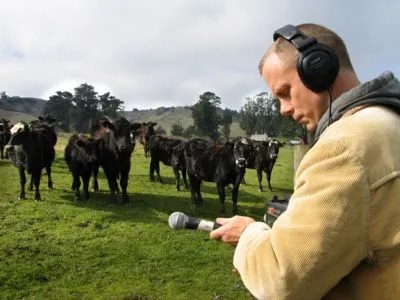
Field recording is the production of audio recordings outside recording studios, and the term applies to recordings of both natural and human-produced sounds. It can also include the recording of electromagnetic fields or vibrations using different microphones like a passive magnetic antenna for electromagnetic recordings or contact microphones, or underwater field recordings made with hydrophones to capture the sounds and/or movements of whales, or other sealife. These recordings are often regarded as being very useful for sound designers and foley artists. Field recording of natural sounds, also called phonography (a term chosen because of the similarity of the practice to photography), was originally developed as a documentary adjunct to research work in the field, and Foley work for film. With the introduction of high-quality, portable recording equipment, it has subsequently become an evocative artform in itself. In the 1970s, both processed and natural phonographic recordings, (pioneered by Irv Teibel's Environments series), became popular. "Field recordings" may also refer to simple monaural or stereo recordings taken of musicians in familiar and casual surroundings, such as the ethnomusicology recordings pioneered by John Lomax, Nonesuch Records, and Vanguard Records.
Also on this shelf
David Finn.
Joel Meyerowitz.
See also
Uncatalogued shelfText from Wikipedia; plate via Wikimedia Commons. Text CC BY-SA 4.0; plate freely licensed (see Commons). Source record. Images and catalogue data are reproduced from open-access collections.