Photography
20th-century Western painting
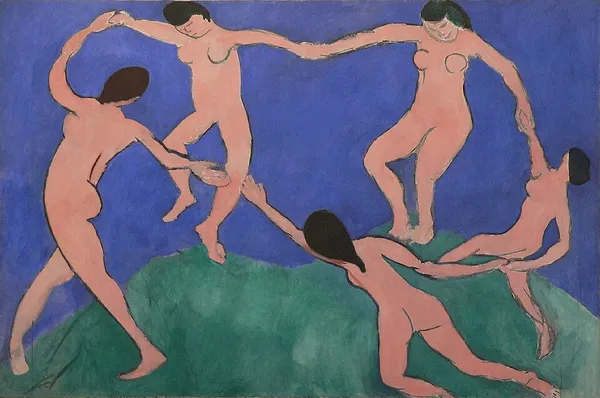
20th-century Western painting begins with the heritage of late-19th-century painters Vincent van Gogh, Paul Cézanne, Paul Gauguin, Georges Seurat, Henri de Toulouse-Lautrec, and others who were essential for the development of modern art. At the beginning of the 20th century, Henri Matisse and several other young artists including the pre-cubist Georges Braque, André Derain, Raoul Dufy and Maurice de Vlaminck, revolutionized the Paris art world with "wild", multi-colored, expressive landscapes and figure paintings that the critics called Fauvism. Matisse's second version of The Dance signified a key point in his career and in the development of modern painting. It reflected Matisse's incipient fascination with primitive art: the intense warm color of the figures against the cool blue-green background and the rhythmical succession of the dancing nudes convey the feelings of emotional liberation and hedonism. Initially influenced by Toulouse-Lautrec, Gauguin, and other late-19th-century innovators, Pablo Picasso made his first cubist paintings based on Cézanne's idea that all depiction of nature can be reduced to three solids: cube, sphere, and cone. With the painting Les Demoiselles d'Avignon (1907; see gallery) Picasso created a new and radical picture depicting a raw and primitive brothel scene with five prostitutes, violently painted women, reminiscent of African tribal masks and his own new proto-Cubist inventions. Analytic cubism, exemplified by Violin and Candlestick, Paris, was jointly developed by Pablo Picasso and Georges Braque from about 1908 through 1912. Analytic cubism was followed by Synthetic cubism, characterized by the introduction of different textures, surfaces, collage elements, papier collé and a large variety of merged subject matter. Crystal Cubism was a distilled form of Cubism consistent with a shift between 1915 and 1916 towards a strong emphasis on flat surface activity and large overlapping geometric planes, practised by Braque, Picasso, Jean Metzinger, Albert Gleizes, Juan Gris, Diego Rivera, Henri Laurens, Jacques Lipchitz, Alexander Archipenko, Fernand Léger, and several other artists into the 1920s. During the years between 1910 and the end of World War I and after the heyday of cubism, several movements emerged in Paris.
Also on this shelf
1930s.
Andrew Tshabangu.
See also
Uncatalogued shelfText from Wikipedia; plate via Wikimedia Commons. Text CC BY-SA 4.0; plate freely licensed (see Commons). Source record. Images and catalogue data are reproduced from open-access collections.