Painting and Sculpture
Eugène Chigot
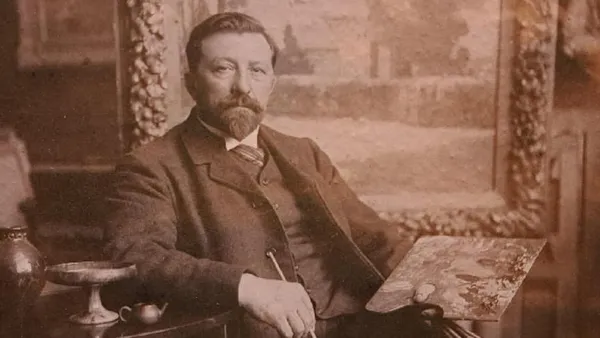
Eugène Henri Alexandre Chigot (French: [øʒɛn ɑ̃ʁi alɛksɑ̃dʁ ʃiɡo]; 22 November 1860 – 14 July 1923) was a French post-impressionist painter. A pupil of his father, the military painter Alphonse Chigot, in 1881 he entered the internationally renowned École des Beaux-Arts in Paris where he was exposed to the ideas of the realist movement of the Barbizon School and to Impressionism. He settled in Étaples in the Pas-de-Calais in an artists’ colony, later returning to Paris where he became a founder of the Salon d’Automne. An official military painter he painted a series of canvases in Calais and Nieuwpoort recording the destruction caused by the First World War. Chigot's reputation was built on his maritime and landscape paintings that arose from his affinity to Flanders and the Pas-de-Calais. He recorded the lives of the people of Flanders placing them within a landscape of soft opalescent light. As a result of his experiences as a Great War artist his later paintings show traces of expressionism and a more vibrant pallette. He was also a nocturne painter who travelled extensively within France, Italy and Spain.
Also on this shelf
Christ and the Adulteress (Titian, Glasgow).
China Art Museum, Shanghai.
See also
Uncatalogued shelfText from Wikipedia; plate via Wikimedia Commons. Text CC BY-SA 4.0; plate freely licensed (see Commons). Source record. Images and catalogue data are reproduced from open-access collections.