Painting and Sculpture
Early Netherlandish painting
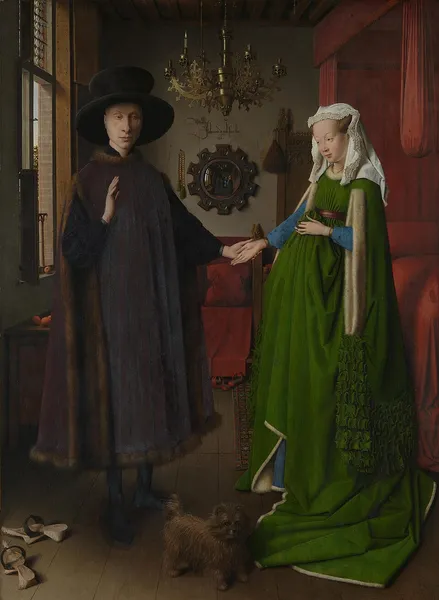
Early Netherlandish painting is the body of work by artists active in the Burgundian and Habsburg Netherlands during the 15th- and 16th-century Northern Renaissance period, once known as the Flemish Primitives. It flourished especially in the cities of Bruges, Ghent, Mechelen, Leuven, Tournai and Brussels, all in present-day Belgium. The period begins approximately with Robert Campin and Jan van Eyck in the 1420s and lasts at least until the death of Gerard David in 1523, although many scholars extend it to the beginning of the Dutch Revolt in 1566 or 1568 – Max J. Friedländer's acclaimed surveys run through Pieter Bruegel the Elder. Early Netherlandish painting coincides with the Early and High Italian Renaissance, but the early period (until about 1500) is seen as an independent artistic evolution, separate from the Renaissance humanism that characterised developments in Italy. Beginning in the 1490s, as increasing numbers of Netherlandish and other Northern painters traveled to Italy, Renaissance ideals and painting styles were incorporated into northern painting. As a result, Early Netherlandish painters are often categorised as belonging to both the Northern Renaissance and the Late or International Gothic. The major Netherlandish painters include Campin, van Eyck, Rogier van der Weyden, Dieric Bouts, Petrus Christus, Hans Memling, Hugo van der Goes and Hieronymus Bosch. These artists made significant advances in natural representation and illusionism, and their work typically features complex iconography. Their subjects are usually religious scenes or small portraits, with narrative painting or mythological subjects being relatively rare. Landscape is often richly described but relegated as a background detail before the early 16th century. The painted works are generally in oils on panel, either as single panels or more complex portable or fixed altarpieces in the form of diptychs, triptychs or polyptychs. The period is also noted for its sculpture, tapestries, illuminated manuscripts, stained glass and carved retables. The first generations of artists were active during the height of Burgundian influence in Europe, when the Low Countries became the political and economic centre of Northern Europe, noted for their crafts and luxury goods.
Also on this shelf
Francisco Zúñiga.
Flight into Egypt (Pareja).
See also
Uncatalogued shelfText from Wikipedia; plate via Wikimedia Commons. Text CC BY-SA 4.0; plate freely licensed (see Commons). Source record. Images and catalogue data are reproduced from open-access collections.