Painting and Sculpture
Joseph's Tunic
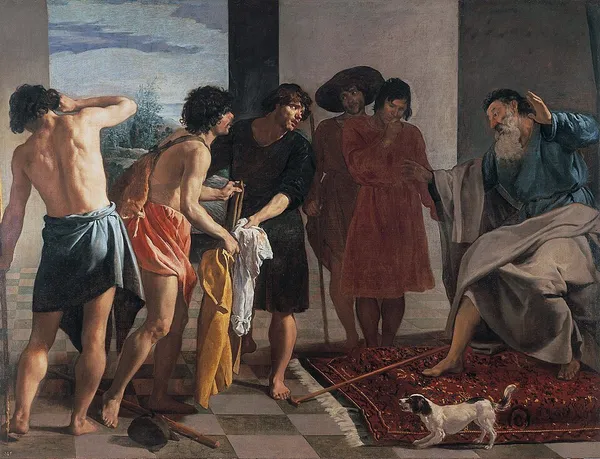
Joseph's Tunic (Spanish: La túnica de José) is a 1630 oil painting by Spanish artist Diego Velázquez, now held in the museum of the Sacristía Mayor del Monasterio de San Lorenzo de El Escorial (Madrid, Spain). The painting is also knowns as Joseph's Bloodied Coat Presented to Jacob. It depicts the Old Testament narrative (Genesis, 37-50) of Joseph's brothers presenting his bloody robe to their father, Jacob. Velázquez painted this work during his first journey to Rome, while staying at the house of Don Manuel de Fonseca y Zúñiga, the Sixth Count of Monterrey and Spanish ambassador to Rome. It was later brought back to Spain with Velázquez's Apollo in the Forge of Vulcan. Despite Joseph's Tunic depicting a biblical story and Apollo in the Forge of Vulcan being a mythological scene, scholars often consider the two paintings a pair. Both works were done without royal commission but were later added to the Spanish royal collection. Their connection lies in their common format, shared use of dramatic realism, and exploration of the power of words. Joseph's Tunic is particularly notable for its use of chiaroscuro, dynamic figure movement, and geometric perspective. The painting also demonstrates influences of Guercino, Caravaggio, Michelangelo, and others.
Also on this shelf
Edward Boccia.
Archibald Kay.
See also
Uncatalogued shelfText from Wikipedia; plate via Wikimedia Commons. Text CC BY-SA 4.0; plate freely licensed (see Commons). Source record. Images and catalogue data are reproduced from open-access collections.