Painting and Sculpture
All in the Past
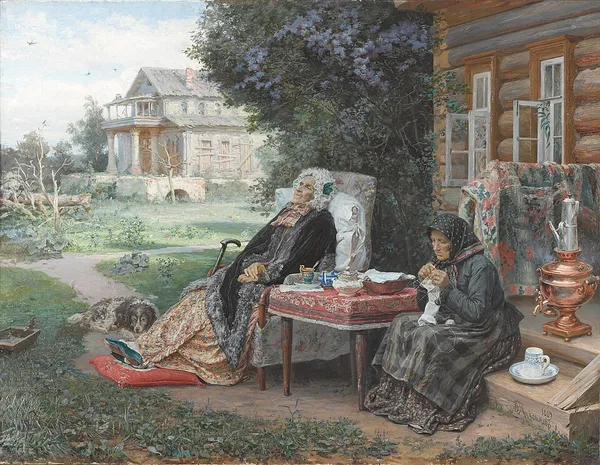
All in the Past (Russian: Всё в прошлом) is a painting by Russian artist Vassily Maximov (1844–1911), completed in 1889. It belongs to the State Tretyakov Gallery (inventory 589). The size of the canvas is 72×93.5 cm. The painting depicts two elderly women: a lady and her maid, sitting on the wing's threshold of an outhouse on a sunny spring day. In the background, the main building of the estate is in a neglected state, with boarded up windows. The artist began to think about painting in 1866, when he lived in Shubino, Tver Governorate. In the 1880s he made a number of studies and sketches for the future canvas. Maximov worked on the painting itself in 1888–1889 at the Lubsha estate on the banks of the Volkhov River, which was inherited by his wife Lydia Alexandrovna in 1885. Work on the painting was completed in early 1889. The canvas was exhibited at the 17th Exhibition of the Society for Travelling Art Exhibitions ("Peredvizhniki"), which opened in St. Petersburg in February 1889. Maximov's painting "was an extraordinary success": the critic Vladimir Stasov wrote that "this is a theme wonderfully taken and wonderfully rendered", and the artist Vasily Polenov noted the "wonderfully true and lively" figures of the barmaid and the maid. After painting "All in the Past" Maximov had no more works of this level. In order to earn a living for himself and his family, he repeated this painting many times, which was very popular with buyers: in total, more than 40 author's repetitions were written. The art historian Alexander Zamoshkin, noting the great skill with which the painting "All in the Past" reveals the theme of the collapse of "noble nests", wrote that after the creation of this work Maximov "rightly took a place in the first row of novelists of Russian painting of the 1890-s". According to art historian Alexei Leonov, the artist "created a canvas of deep social meaning and great artistic expressiveness", which became "a symbol of the passing post-reform Russia".
Also on this shelf
Hasan Djaafar.
Abby Leigh.
See also
Uncatalogued shelfText from Wikipedia; plate via Wikimedia Commons. Text CC BY-SA 4.0; plate freely licensed (see Commons). Source record. Images and catalogue data are reproduced from open-access collections.