Painting and Sculpture
Las Meninas
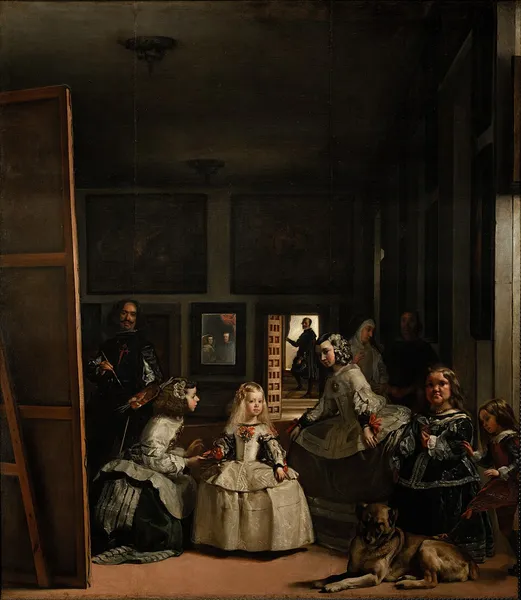
Las Meninas (Spanish: [las meˈninas]; Spanish for 'The Ladies-in-waiting') is a 1656 oil painting in the Museo del Prado in Madrid, by Diego Velázquez, the leading artist in the court of King Philip IV of Spain and Portugal, and of the Spanish Golden Age. It has become one of the most widely analysed works in Western painting for the way its complex and enigmatic composition raises questions about reality and illusion, and for the uncertain relationship it creates between the viewer and the figures depicted. The painting is believed by the art historian F. J. Sánchez Cantón to depict a room in the Royal Alcázar of Madrid during the reign of Philip IV, and presents several figures, most of them identifiable from the Spanish court, captured in a particular moment as if in a snapshot. Some of the figures look out of the canvas towards the viewer, while others interact among themselves. The five-year-old Infanta Margaret Theresa is surrounded by her entourage of maids of honour, chaperone, bodyguard, two dwarfs and a dog. Just behind them, Velázquez portrays himself working at a large canvas. Velázquez looks outwards beyond the pictorial space to where a viewer of the painting would stand. The mirror in the background reflects the upper bodies of the king and queen. They appear to be placed outside the picture space in a position similar to that of the viewer, although some scholars have speculated that their image is a reflection from the painting on which Velázquez is shown working. The Italian Baroque painter Luca Giordano described Las Meninas as the "theology of painting", and in 1827 the president of the Royal Academy of Arts in London Sir Thomas Lawrence called the work "the true philosophy of the art". The painting has since become a focal point for scholarly debates about representation, spectatorship, and the social status of the artist. Michel Foucault opened The Order of Things (1966) with an extended analysis of its treatment of classical representation; Svetlana Alpers read it as Velázquez's claim for painting as a liberal art; and Leo Steinberg (1981) and Joel Snyder (1985) have offered competing accounts of its spatial logic and the function of the mirror on the back wall.
Also on this shelf
Harvest Time (Mowers).
Enclosed Field with Peasant.
See also
Uncatalogued shelfText from Wikipedia; plate via Wikimedia Commons. Text CC BY-SA 4.0; plate freely licensed (see Commons). Source record. Images and catalogue data are reproduced from open-access collections.