Painting and Sculpture
Batalha dos Guararapes
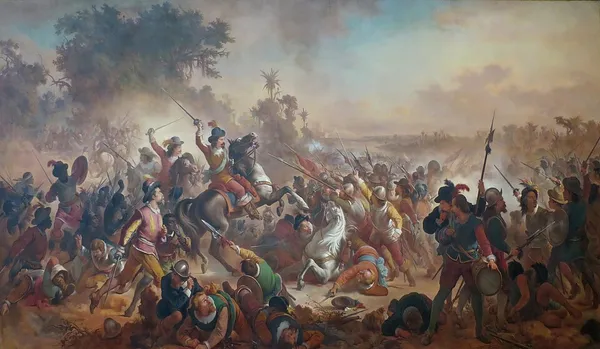
Batalha dos Guararapes (English: Battle of Guararapes) is an oil painting created between 1875 and 1879. It represents a history painting from the first confrontation of the Battle of Guararapes that took place in the 17th century in the Captaincy of Pernambuco, which culminated with the banishment of the Dutch invaders from Brazilian lands. The canvas was painted by the Brazilian artist and professor of historical painting Victor Meirelles and the scene represents the victory of the Brazilian troops against the Dutch on April 19, 1648, in the first of the two confrontations that occurred in that battle, fought in the region of Guararapes Hill. The second confrontation would be fought months later at the same location, on February 19, 1649, leading to the definitive expulsion of the Dutch troops from the colony, which would only occur in January 1654, with the signing of their capitulation. Initially, the painting on the battle would have been assigned to the painter Pedro Américo from Paraíba, commissioned by the Minister of the Empire João Alfredo Correia de Oliveira. Once the proposal was accepted, the painter went to Italy and stayed at the Convent Santissima Annunziata, Florence to start the painting. Pedro Américo gave up painting the commissioned battle and decided to do a canvas portraying the Paraguayan War, which would be called the Battle of Avaí. With this decision, the minister transferred the commission to Victor Meirelles in 1872: Meirelles' work is one of the historical paintings that circulated most in Brazil, along with canvases such as First Mass in Brazill, also by him, and Independence or Death, by Pedro Américo. It was shown at the 25th General Exposition of the Imperial Academy of Fine Arts in 1879, in Rio de Janeiro, to some three hundred thousand visitors. There were also works by Pedro Americo in the exhibition, such as the Battle of Avaí, both representing victorious episodes in the "national military history". The exhibition, which at first highlighted the qualities of the paintings, displayed side by side, began to be marked by an atmosphere of rivalry between the authors, instigated by the opinions of the press. This battle also has the particularity of being the first moment of national communion in Brazilian history, with regard to the defense of the territory against invaders.
Also on this shelf
Fu Wenjun.
Ellen Day Hale.
See also
Uncatalogued shelfText from Wikipedia; plate via Wikimedia Commons. Text CC BY-SA 4.0; plate freely licensed (see Commons). Source record. Images and catalogue data are reproduced from open-access collections.