Natural History
Geography of Australia
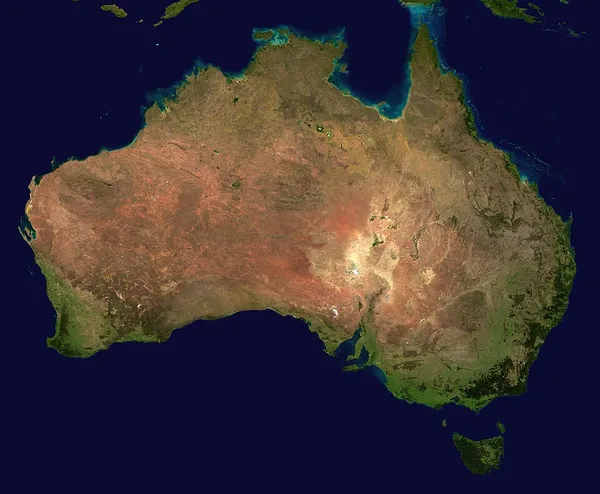
Australia, officially the Commonwealth of Australia, is a sovereign country comprising the mainland of the Australian continent, the island state of Tasmania, and thousands of minor islands. It occupies a total area of 7,688,287 km2 (2,968,464 sq mi), making it the sixth-largest country in the world. Located in the Southern Hemisphere between the Indian and Pacific oceans, Australia's jurisdiction spreads across thousands of kilometres beyond the main landmass, including Norfolk Island, Christmas Island, the Cocos (Keeling) Islands, the Coral Sea Islands, Ashmore and Cartier Islands, the Heard and McDonald Islands in the southern Indian Ocean and thousands of other islands, as well as the Australian Antarctic Territory, a territorial claim covering almost half of the continent. The country's geography encompasses a wide range of environments, from arid and semi-arid interior regions to tropical rainforests, temperate woodlands, and alpine areas. Most of the population lives in the temperate coastal zones of the east, southeast, and southwest, while the heartland—known as the Outback—is sparsely populated and characterised by semi-arid and desert landscapes. Australia's geographic isolation and environmental variety have contributed to its distinctive landforms and exceptionally high levels of endemic biodiversity. Furthermore, its peculiar position in the middle of the Australian plate makes Australian territory one of the least geologically active in the world, with little volcanic and seismic activity.
Also on this shelf
Indian Institute of Forest Management.
Courland Peninsula.
See also
Uncatalogued shelfText from Wikipedia; plate via Wikimedia Commons. Text CC BY-SA 4.0; plate freely licensed (see Commons). Source record. Images and catalogue data are reproduced from open-access collections.