Natural History
Honey badger
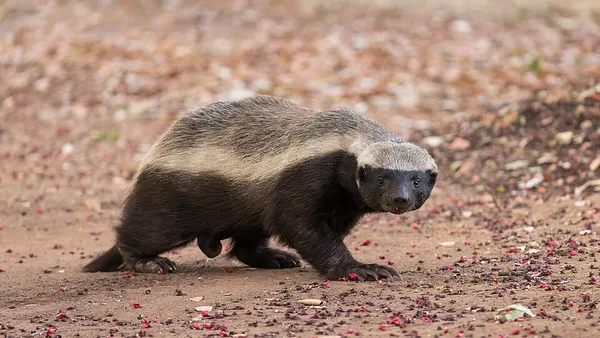
The honey badger (Mellivora capensis), also known as the ratel ( or ), is a mammal widely distributed across Africa, Southwest Asia, and the Indian subcontinent. It is the sole living representative of the Mellivorinae subfamily of the Mustelidae. It has a fairly long body, with a distinctly thick-set and broad back, and remarkably loose skin, allowing the badger to turn and twist freely within it. The largest terrestrial mustelid in Africa, the honey badger measures 55 to 77 cm (22 to 30 in) long and weighs up to 16 kg (35 lb). Sexual dimorphism has been recorded in this species, with males being larger and heavier than females. It has two pairs of mammae, and an eversible anal pouch. The honey badger is a solitary animal that can be active at any time of day, depending on the location. It is primarily a carnivorous species and has few natural predators because of its thick skin, strength and ferocious defensive abilities. Adults maintain large home ranges, and display scent-marking behavior. The species has no fixed breeding period. After a gestation of 50–70 days, a female will give birth to an average of one to two cubs that will remain under her care for 1–1+1⁄4 years. Because of its wide range and occurrence in a variety of habitats, it is listed as least concern on the IUCN Red List. In popular media, the honey badger is best known as an aggressive, intelligent animal that is fearless and tough in nature.
Also on this shelf
Common starling.
Comparative psychology.
See also
Uncatalogued shelfText from Wikipedia; plate via Wikimedia Commons. Text CC BY-SA 4.0; plate freely licensed (see Commons). Source record. Images and catalogue data are reproduced from open-access collections.