Natural History
Boreal woodland caribou
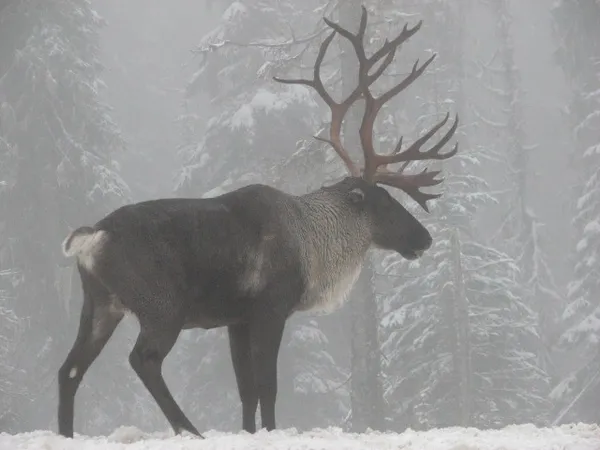
The boreal woodland caribou (Rangifer tarandus caribou; but subject to a recent taxonomic revision. See Reindeer: Taxonomy), also known as Eastern woodland caribou, boreal forest caribou and forest-dwelling caribou, is a North American subspecies of reindeer (or caribou in North America) found primarily in Canada with small populations in the United States. Unlike the Porcupine caribou and barren-ground caribou, boreal woodland caribou are primarily (but not always) sedentary. The boreal woodland caribou is the third largest of the caribou ecotypes after the Selkirk Mountains caribou and Osborn's caribou (see Reindeer: Taxonomy) and is darker in color than the barren-ground caribou. Valerius Geist, specialist on large North American mammals, described the "true" woodland caribou as "the uniformly dark, small-maned type with the frontally emphasized, flat-beamed antlers" which is "scattered thinly along the southern rim of North American caribou distribution". Geist asserted that "the true woodland caribou is very rare, in very great difficulties and requires the most urgent of attention", but suggests that this urgency is compromised by the inclusion of the Newfoundland caribou, the Labrador caribou, and Osborn's caribou in the Rangifer tarandus caribou subspecies. In Geist's opinion, the inclusion of these additional populations obscures the precarious position of the "true" woodland caribou. A recent revision, recognizing Labrador and Newfoundland caribou as distinct subspecies of woodland caribou, partially rectifies this problem. They prefer lichen-rich, mature forests, and mainly live in marshes, bogs, lakes and river regions. The historic range of the woodland caribou covered over half of present-day Canada, stretching from Yukon to Newfoundland and Labrador. The national meta-population of this sedentary boreal ecotype spans the boreal forest from the Northwest Territories to Labrador (but not Newfoundland). Their former range stretched south into the contiguous United States. By 2019, the last individual in the Lower 48 (a female) was captured and taken to a rehab center in British Columbia, thus marking the extirpation of the caribou in the contiguous U.S. The boreal woodland caribou was designated as Threatened in 2002 by the Committee on the Status of Endangered Wildlife in Canada (COSEWIC).
Also on this shelf
Invasive species in Mexico.
De-extinction.
See also
Uncatalogued shelfText from Wikipedia; plate via Wikimedia Commons. Text CC BY-SA 4.0; plate freely licensed (see Commons). Source record. Images and catalogue data are reproduced from open-access collections.