Natural History
Body size and species richness
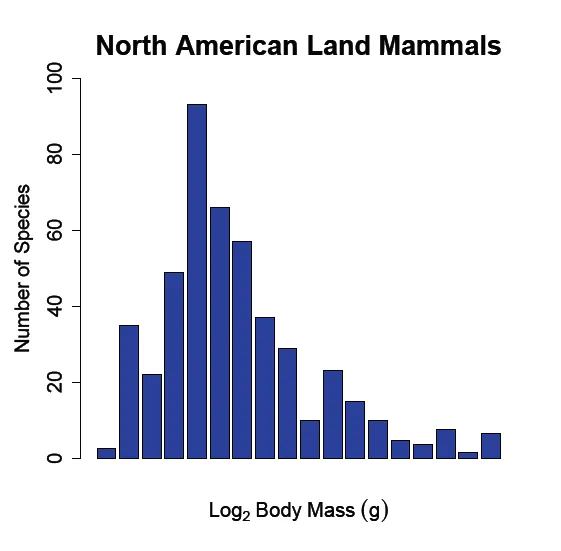
The body size-species richness distribution is a pattern observed in the way taxa are distributed over large spatial scales. The number of species that exhibit small body size generally far exceeds the number of species that are large-bodied. Macroecology has long sought to understand the mechanisms that underlie the patterns of biodiversity, such as the body size-species richness pattern. This pattern was first observed by Hutchinson and MacArthur (1959), and it appears to apply equally well to a broad range of taxa: from birds and mammals to insects, bacteria (May, 1978; Brown and Nicoletto, 1991) and deep sea gastropods (McClain, 2004). Nonetheless, its ubiquity remains undecided. Most studies focus on the distribution of taxonomic fractions of largely non-interacting species such as birds or mammals; this article is primarily based on those data.
Also on this shelf
Anthracosauria.
Caracal (genus).
See also
Uncatalogued shelfText from Wikipedia; plate via Wikimedia Commons. Text CC BY-SA 4.0; plate freely licensed (see Commons). Source record. Images and catalogue data are reproduced from open-access collections.