Natural History
Gray whale
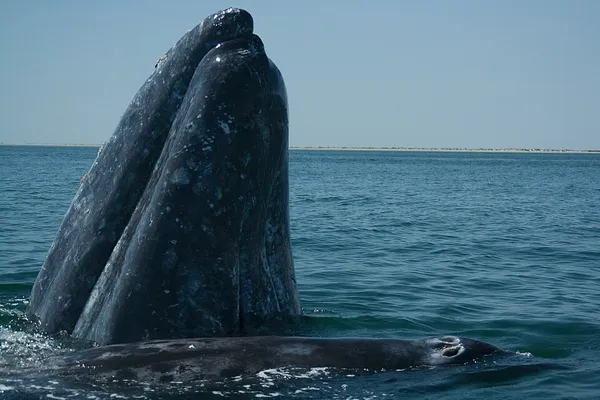
The gray whale (Eschrichtius robustus), also known as the grey whale, is a baleen whale that migrates between feeding and breeding grounds yearly. It reaches a length of 14.9–15.2 m (49–50 ft), a weight of up to 41 to 45 tonnes (45 to 50 short tons; 40 to 44 long tons) and lives between 55 and 70 years, although one female was estimated to be 75–80 years of age. One of the longest-living gray whales currently is a female, first sighted in 1977, and estimated to be 53–55 years old as of 2024. The common name of the whale comes from the gray patches and white mottling on its dark skin. Gray whales were once called "devil fish" because of their fighting behavior when hunted, with mothers accompanied by their calves fighting viciously to protect their young if they are attacked. The gray whale is the sole living species in the genus Eschrichtius. It is the sole living genus in the family Eschrichtiidae; however, some recent studies classify it as a member of the family Balaenopteridae. This mammal is descended from filter-feeding whales that appeared during the Neogene. The gray whale is distributed in a Northeast Pacific (North American), and an endangered Northwest Pacific (Asian), population. North Atlantic populations were extirpated (perhaps by whaling) on the European coast in the 12th to 14th centuries, and on the American and African Atlantic coasts around the late 17th to early 18th centuries. However, in the 2010s and 2020s there have been rare sightings of gray whales in the North Atlantic, Mediterranean, and even off South Atlantic coasts.
Also on this shelf
Bug Landscape Park.
Fairy pitta.
See also
Uncatalogued shelfText from Wikipedia; plate via Wikimedia Commons. Text CC BY-SA 4.0; plate freely licensed (see Commons). Source record. Images and catalogue data are reproduced from open-access collections.