Natural History
Adaptive radiation
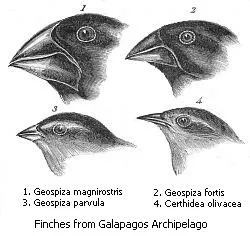
In evolutionary biology, adaptive radiation is a process in which organisms diversify rapidly from an ancestral species into a multitude of new forms, particularly when a change in the environment makes new resources available, alters biotic interactions or opens new environmental niches. Starting with a single ancestor, this process results in the speciation and phenotypic adaptation of an array of species exhibiting different morphological and physiological traits. The prototypical example of adaptive radiation is finch speciation on the Galapagos ("Darwin's finches"), but examples are known from around the world.
Also on this shelf
European wildcat.
Cedar Creek Ecosystem Science Reserve.
See also
Uncatalogued shelfText from Wikipedia; plate via Wikimedia Commons. Text CC BY-SA 4.0; plate freely licensed (see Commons). Source record. Images and catalogue data are reproduced from open-access collections.