Natural History
Fauna of India
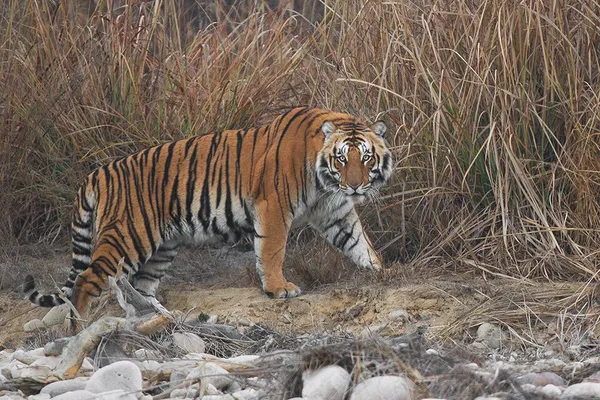
India is the world's 8th most biodiverse region with a 0.46 BioD score on diversity index, 102,718 species of fauna and 23.39% of the nation's geographical area under forest and tree cover in 2020. India encompasses a wide range of biomes: desert, high mountains, highlands, tropical and temperate forests, swamplands, plains, grasslands, areas surrounding rivers, as well as island archipelago. Officially, four out of the 36 Biodiversity Hotspots in the world are present in India: the Himalayas, the Western Ghats, the Indo-Burma and the Nicobar Islands. To these may be added the Sundarbans and the Terrai-Duar Savannah grasslands for their unique foliage and animal species. These hotspots have numerous endemic species. Nearly 5% of India's total area is formally classified under protected areas . India, for the most part, lies within the Indomalayan realm, with the upper reaches of the Himalayas forming part of the Palearctic realm; the contours of 2000 to 2500m are considered to be the altitudinal boundary between the Indo-Malayan and Palearctic zones. India displays significant biodiversity. One of seventeen megadiverse countries, it is home to 7.6% of all mammalian, 12.6% of all avian, 6.2% of all reptilian, 4.4% of all amphibian and 11.7% of all fish. The region is also heavily influenced by summer monsoons that cause major seasonal changes in vegetation and habitat. India forms a large part of the Indomalayan biogeographical zone and many of the floral and faunal forms show Malayan affinities with only a few taxa being unique to the Indian region. The unique forms include the snake family Uropeltidae found only in the Western Ghats and Sri Lanka. Fossil taxa from the Cretaceous show links to the Seychelles and Madagascar chain of islands. The Cretaceous fauna include reptiles, amphibians and fishes and an extant species demonstrating this phylogeographical link is the purple frog. The separation of India and Madagascar is traditionally estimated to have taken place about 88 million years ago. However, there are suggestions that the links to Madagascar and Africa were present even at the time when the Indian subcontinent met Eurasia. India has been suggested as a ship for the movement of several African taxa into Asia.
Also on this shelf
Attwater Prairie Chicken National Wildlife Refuge.
Gran Paradiso National Park.
See also
Uncatalogued shelfText from Wikipedia; plate via Wikimedia Commons. Text CC BY-SA 4.0; plate freely licensed (see Commons). Source record. Images and catalogue data are reproduced from open-access collections.