Natural History
Banksia ericifolia
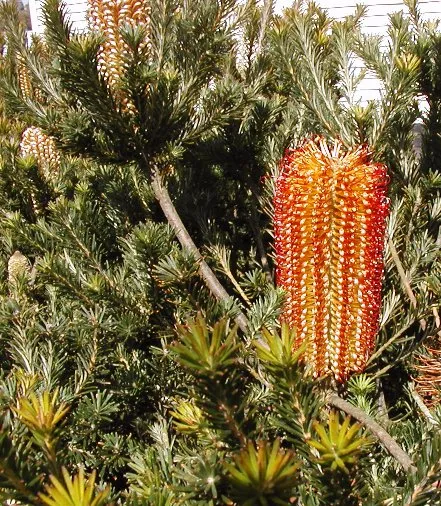
Banksia ericifolia, the heath-leaved banksia, or lantern banksia, is a species of woody shrub of the family Proteaceae native to Australia. It grows in two separate regions of Central and Northern New South Wales east of the Great Dividing Range. Well known for its orange or red autumn inflorescences, which contrast with its green fine-leaved heath-like foliage, it is a medium to large shrub that can reach 6 m (20 ft) high and wide, though is usually half that size. In exposed heathlands and coastal areas, it is more often 1–2 m (3.3–6.6 ft). Banksia ericifolia was one of the original Banksia species collected by Joseph Banks around Botany Bay in 1770 and was named by Carl Linnaeus the Younger, son of Carl Linnaeus, in 1782. A distinctive plant, it has split into two subspecies: Banksia ericifolia subspecies ericifolia of the Sydney region and Banksia ericifolia subspecies macrantha of the New South Wales Far North Coast which was recognised in 1996. Banksia ericifolia has been widely grown in Australian gardens on the east coast for many years, and is used to a limited extent in the cut flower industry. Compact dwarf cultivars such as Banksia 'Little Eric' have become more popular in recent years with the trend toward smaller gardens.
Also on this shelf
Bhutan takin.
Fauna of Turkey.
See also
Uncatalogued shelfText from Wikipedia; plate via Wikimedia Commons. Text CC BY-SA 4.0; plate freely licensed (see Commons). Source record. Images and catalogue data are reproduced from open-access collections.