Natural History
Environmental impact of wind power
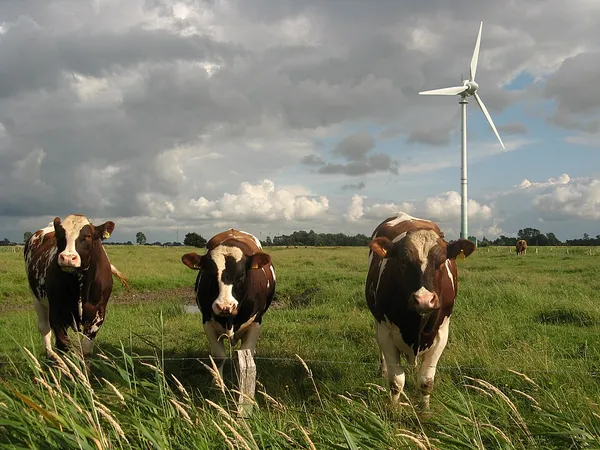
The environmental impact of electricity generation from wind power is minor when compared to that of fossil fuel power. Wind power consumes no fuel, and emits no air pollution, unlike fossil fuels. Wind turbines have some of the lowest global warming potential per unit of electricity generated: far less greenhouse gas is emitted than for the average unit of electricity, so wind power helps limit climate change. Emissions from production of a turbine are recouped in less than a year of operation, as it replaces gas or coal power. Onshore (on-land) wind farms can have a significant visual impact and impact on the landscape. Due to a very low surface power density and spacing requirements, wind farms typically need to be spread over more land than other power stations. Conflicts arise especially in scenic and culturally-important landscapes. Siting restrictions, such as setbacks, may be implemented to limit the impact. The land between the turbines and access roads can still be used for farming and grazing. Some wind farms are opposed for potentially spoiling protected scenic areas, archaeological landscapes and heritage sites. Many wind turbine blades are made of fiberglass and some only had a lifetime of 10 to 20 years. Previously, there was no market for recycling these old blades, and they were commonly disposed of in landfills. Because blades are hollow, they take up a large volume compared to their mass. Since 2019, some landfill operators have begun requiring blades to be crushed before being landfilled. Blade end-of-life is complicated, and blades manufactured in the 2020s are more likely to be designed to be completely recyclable. Wind turbines also generate noise. At a distance of 300 metres (980 ft) this may be around 45 dB, which is slightly louder than a refrigerator. At 1.5 km (1 mi) distance they become inaudible. Some people who live very close to wind turbines have reported negative health effects, but peer-reviewed research has generally not supported these claims. Pile-driving to construct non-floating wind farms is noisy underwater, but in operation offshore wind is much quieter than ships. Habitat loss and fragmentation are the greatest potential impacts on wildlife of onshore wind farms, but the worldwide ecological impact is minimal.
Also on this shelf
Koyna Wildlife Sanctuary.
Cabras Islets.
See also
Uncatalogued shelfText from Wikipedia; plate via Wikimedia Commons. Text CC BY-SA 4.0; plate freely licensed (see Commons). Source record. Images and catalogue data are reproduced from open-access collections.