Natural History
2020–2026 H5N1 outbreak
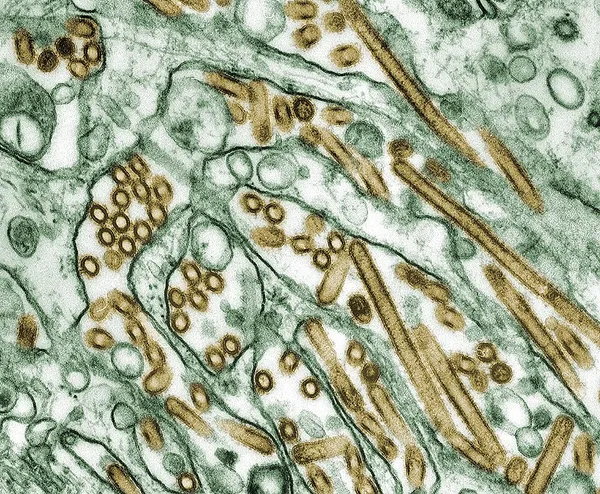
Outbreaks of avian influenza subtype H5N1 have been occurring since 2020, with cases reported from every continent. Some species of wild aquatic birds act as natural asymptomatic carriers of influenza A viruses, which can infect poultry, other bird species, mammals (including humans) if they come into close contact with infected feces or contaminated material, or by eating infected birds. The virus strain involved in the global outbreak is classified as H5N1 clade 2.3.4.4b, which has adapted to cause significant outbreaks in a broader range of species, mammals included. H5N6 and H5N8 viruses with the H5-2.3.4.4b hemagglutinin (HA) gene became the dominant avian influenza viruses globally in 2018–2020 (see 2020–2023 H5N8 outbreak). In 2020, reassortment (genetic "swapping") between these H5-2.3.4.4b viruses and other strains of avian influenza led to the emergence of a H5N1 strain with a H5-2.3.4.4b gene. The virus then spread across Europe, first detected there in the autumn of 2020, before spreading to Africa and Asia. It continues to swap genes with local flu viruses as it crosses the globe. As of June 2026, H5N1 avian influenza is widespread in wild bird populations, in all continents frequently spilling over into poultry flocks, necessitating mass slaughter established in US dairy cows causing sporadic human cases, generally in people exposed to infected birds or cattle known to have infected at least 43 species of mammal Human trials of a vaccine commenced in April 2026.
Also on this shelf
Borneo montane rain forests.
Cretaceous–Paleogene extinction event.
See also
Uncatalogued shelfText from Wikipedia; plate via Wikimedia Commons. Text CC BY-SA 4.0; plate freely licensed (see Commons). Source record. Images and catalogue data are reproduced from open-access collections.